Thursday, 26 July 2012

The Beachcomber - brunch at the beach

It was a busy weekend of birthdays, balloons and the beach. We were blessed with winter sunshine, good food and good company.  And who isn't cheered up by a blue sky over the shoreline, even if it is too cold to swim in the sea.  My brother Andy had wisely chosen to have his birthday brunch at The Beachcomber Cafe in St Kilda.  It has huge windows out onto the beach and a good selection of food.

The cafe was spacious.  Our party of 11 adults and 6 kids easily found room inside, though all the seating outside was busy.  One can only imagine that it must be bursting at the seams in summer.  Likewise the menu is large with something for everyone.  Our table of omnivores, vegetarians, celiacs and fussy eaters were all pleased.  On offer was gluten free toast, a big breakfast with lots of variety and a decent children's menu.

I chose the home made baked beans with toast.  I enjoyed them.  They were on the sweet side but the beans were soft and the sauce was generous.  Sylvia and I shared a Berry smoothie.  It was chock-full of mixed berries, frozen yoghurt and tropical juice.  Unlike many smoothies I encounter in cafes, it was fruity rather than milky and was pleasingly thick.

Sylvia had the pancakes with maple syrup off the children's menu.  She gobbled them up before I had a chance to even have a taste.  The waitress didn't have a problem with leaving the cream off her pancakes order or with changes to the big brekkie when E ordered.  And when the kids got restless, we took them outside to play in the sand.  It was lots of fun with sandcastles, cartwheels and seashells.

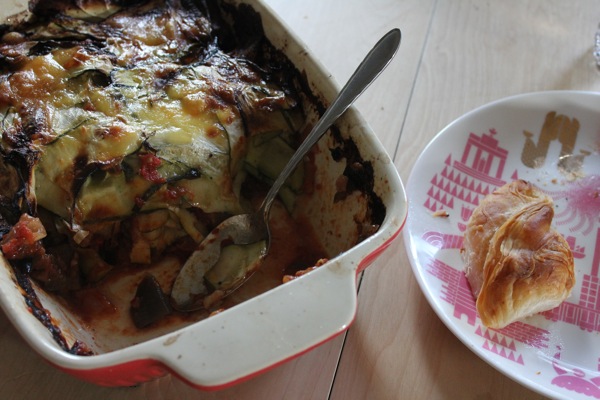
Also on the weekend I visited my mum who made an amazing lunch.  I must get the recipe to the above zucchini and eggplant bake from Ottolenghi.  She served it with green salad, cheese pastries and bread.  For afters there were fluffly buttermilk scones and a delicious layer cake warm out of the oven, sandwiched together with raspberry jam.  Not a bad effort after flying home from Ireland 3 days earlier.  After lunch, we visited my sister, Susie, in her lovely new house. 

Less sunny but equally enjoyable was our visit to the Edinburgh Castle Hotel late in the afternoon.  E was playing with his ukelele group.  They seem to have lots of fun.  There were cowboy costumes, kazoos and jokes.  And lots of lively music that got us up and dancing.

I ordered chips for the three of us.  They were hot and crispy.  In fact, if we hadn't had a fridge full of leftovers I might have even stayed for dinner.  But there was pizza, tofu nut balls and my mum's baking.  We headed out into the cold night for a long wait for the tram.  Oh well, at least there were no problems with navigation and parking!


The Beachcomber Cafe
10-18 Jacka Boulevard (near St Kilda Pier)
St Kilda Victoria 3182
(03) 9593 8233
www.beachcombercafe.com.au

Tuesday, 24 July 2012

WSC Chocolate thumbprints and a stew

A challenge from Choclette and inspiration from Kari led us into the supermarket on the way home one evening last week.  We were seeking blackcurrant jam for thumbprint biscuits (or cookies).  I had already been to the supermarket earlier that day but I was too busy child-wrangling to remember the thing I had gone to buy.  I had expected one of the fancier labels to make blackcurrant jam.  All I could find was homebrand and plain old Cottees.

We came home with a jar of Cottees blackcurrant jam to freshly shelled walnuts and some walnut babies that we had made earlier in the afternoon.  (I didn't have any beads like the template I was following so we used playdough which worked ok unless a wee thumb was pressed into it.)

It was late by the time we started baking.  Fortunately I had fed Sylvia as much dinner as possible.  The mixture was so good that I considered eating it instead of making my own dinner.  Sylvia loved it so much that she went and found a spoon.  I think she intended to eat her body weight in the mixture.  I had to put a stop to that.  Though I was tempted to do the same thing myself!  We told each other many times that it was sooooooooo delicious.

I love seeing where people get ideas.  Kari's recipe had evolved from two very different recipes.  I chose to make my biscuits a bit like the richer recipe she used by adding in some ground walnuts and chocolate.  I was also delighted to find an opportunity to use some walnut oil.  As Kari said, it was as good as brownies.  But more portable.  Think of a cross between a brownie and a jammy dodger.

The biscuits were also an ideal opportunity to create a blackcurrant recipe for We Should Cocoa.  Sylvia wanted apricot jam so I used apricot in half the bikkies and blackcurrant in the other half.  I used far less jam than Kari but I followed her lead in baking the biscuits, pressing a thumb (or in my case a half teaspoon measure because the biscuits were so hot), adding jam and returning to the oven for a few minutes.  The jam straight out of the oven seemed so liquid that I was sure it would never set.  Yet it did gel more once the biscuits cooled.  The only other time I have made thumbprint biscuits on my blog, I added the jam before baking, which seems more straightforward.  I wish I had the time and energy to experiment and tell you which way I recommend.

After tasting some mixture and one or two cooked biscuits (for research, of course) I really did need something savoury.  I intended to bake a Casserole of Lentils Rice and Sausage in the oven like Kalyn's but I ran out of puff and once it was cooked on the stovetop, I served it up.  My expectations were low.  E loved it and so did I.  I think it could do with more experiments but it was very good as it came.


Previously on Green Gourmet Giraffe:
One year ago: Pumpkin cake for Dolly's tea party
Two years ago: Lentil quinoa balls and fun links
Three years ago: Morning Rush Muffins
Four years ago: Vegetarian Cassoulet
Five years ago: Mushroom Yoghurt Pie with Spinach Crust

Chocolate walnut thumbprint biscuits

Adapted from Bite Sized Thoughts and Kitchen Daily
Makes about 24 biscuits

70g dark chocolate
1/3 cup walnut oil (or neutral oil)
1/4 cup milk (I used soy milk)
2/3 cup (scant) brown sugar
2 tbsp cocoa
1 tbsp dessicated coconut
1/2 cup walnuts
1/2 cup wholemeal plain flour
1/4 cup plain white flour
1 tsp baking powder
Jam (I think I used about 1/4 cup)

Preheat oven to 180 C and line two oven trays. Finely grind walnuts. Break chocolate into small chunks in a microwave proof mixing bowl and gently melt in the microwave. Mix in remaining ingredients, except jam. Try not to eat the bowlful before you get it in the oven (it is that good). Roll mixture into balls about the size of a walnut. *Make a dent in each with your thumb and drop in about 1/4 tsp jam (I found this enough but add more if desired). Bake for about 12 minutes or until cooked on the outside. Cool on the trays and store in an airtight container.

* I cooked mine for 10 minutes and then made a depression with a half tsp measure because the biscuits were hot and then added jam and returned to the oven for 2-4 minutes. However, as discussed above, I think I would like to try putting the jam in before baking.

Rice, sausage and lentil stew
Inspired by Kalyn's Kitchen
serves about 4-6

2-3 tsp olive oil
1 large onion, chopped
2 large carrots, grated
6 vegetarian sausages, chopped
350g passata
1/2 tsp wild garlic salt
1 clove garlic
2 cups cooked rice
400g tin lentils, rinsed and drained
shake of smoked paprika
(Note: I think sultanas might be interesting in here but didn't think of this til later)

Gently cook onion in olive oil over a large frypan until very soft and caramelised. While you are cooking onion, grate carrots and add to onions as they cook. Now add in chopped sausages and keep cooking (I did wonder about cooking these sausages first but didn't have time). When onions and carrots are well cooked, add in remaining ingredients. Check seasoning. Bring to the boil and simmer for about 10-15 minutes to warm through and thicken the sauce.

On the stereo:
Music to watch girls go by: Various Artists

Sunday, 22 July 2012

WW Tofu nut balls and princesses

One thing leads to another.  Leftover rice led me to a favourite recipe for Tofu Nut Balls.  Buying craft stuff with Sylvia leads us to Spotlight where we bought fabric for blogging photos.  Making princesses and monsters out of old toilet paper rolls leads to ideas for decorating a birthday card.

Here are the princesses and monsters.  The monsters have jangly bells on pipecleaners through holes make with a hole punch.  I meant to make some crazy hair too but the pipecleaners took over.  Googly eyes are lots of fun.  I was impressed that Sylvia wanted trousers on her princess.  I cut out a crown top and tried a few ideas for hair on our princesses.

The hair idea transferred nicely to a princess birthday card.  It was a joint effort between Sylvia and me.  I was pleased to find a use for the ribbon that has been hanging around the house for ages.  Sylvia decided on one green eye and one pink eye.  I'm thinking of trying this card with fabrics rather than paper.

The birthday card was made while these tofu nut balls baked in the oven.  I needed something quick to get dinner underway and, with a tub of old rice, I found we had everything I needed for tofu nut balls.  It is a simple ingredient list and they are easy to make.  The Enchanted Broccoli Forest by Mollie Katzen was one of the first vegetarian cookbooks I owned.  These tofu nut balls were a magical discovery all those years ago.

I wonder if I would find them quite as amazing if I found the recipe today.  Probably not.  I have encountered many vegetarian burgers since then and they have quite a few similarities to nut roasts.  However, I still find them easy and delicious.  They are equally good as nibbles at a party or vegetarian meatballs with pasta.

Mollie suggests serving them with tomato sauce or mushroom tahini sauce.  I have tried both and prefer tomato sauce.  I made a basic one to serve these with on Friday night - olive oil, onions, garlic, a tin of tomatoes, salt, maple syrup and worcestershire sauce.  Simply yummy.  (I imagine a pumpkin sauce or a pesto sauce would be great too.)

It was a simple dinner with some steamed broccoli and brussels sprouts on the side.  That was all we needed between last week's baking and the weekend's social meals. 

One things leads to another.  A healthy meal leads to Ricki's Wellness Weekends and I have no doubt that visiting the Wellness Weekends page will lead to many interesting and delicious blog entries.  I am also sending the monsters and princesses to Red Ted's Art Blog, a recently discovered source of inspiration for craft.

Lastly, my concern about Shabby Blogs has lead me to take them off my blog design and replace the wallpaper with a new one - check out this post to see the progression of designs on my blog.

Previously on Green Gourmet Giraffe:
One year ago: MLLA Chickpea, potato and tomato stew
Two years ago: Syrup cake, shoes and chooks
Three years ago: SHF Apricot sponge – by any other name
Four years ago: Stouty Oatmeal Beer Bread
Five years ago: Sesame and Lemon Bread

Tofu nut balls
From The Enchanted Broccoli Forest by Mollie Katzen
serves about 4

3/4 cup cooked brown rice (or cook 1/2 cup dried brown rice)
225g firm tofu
2 tbsp tamari
1/2 cup ground almonds
1/2 cup wheatgerm
oil spray (or oil for frying)

Place 1/2 cup cooked rice and 110g of tofu with all the tamari in a food processor or blender and blend to make a smooth paste.  Mash up remaining tofu in a mixing bowl.  Add rice and tofu paste, almonds and wheatgerm.  Stir thoroughly until you have a stiff mixture.  Roll into balls the size of walnuts.  Spray with oil spray and and bake on oven tray at 180 C for about 30 minutes or until golden brown (mine took longer) or shallow fry until golden brown.

On the Stereo:
Unknown Deutschland: the Krautrock Archive, vol 2: Various Artists

Saturday, 21 July 2012

For the Love of Pizza - good food and good fun

Tonight we went to For the Love of Pizza in Northcote for a birthday dinner for Sylvia's friend, Amelia.  The place was fairly plain but the menu was extensive, the pizzas thin and tasty, and the staff friendly.  As the children donned their sparkly party hats, they were each given a blob of pizza dough to play with on a handful of semolina.  Now this is the way to impress three year olds!

The menu offered a few vegetarian choices and lots of entertainment in the pizza names.  I honed in on the Pumpkin.  It appeared to be dominated by the slices of pumpkin when it arrived but in fact had a great balance of flavours.  As well as nicely cooked pumpkin, the toppings included olives, ricotta, tomato, mozzerella and maybe basil.  I loved that the base was crispy and the toppings weren't overwhelmed by cheese.

My pizza was so good that I didn't regret not ordering the hallouminati pizza or the potato one.  E loved his meatballs pizza.  Everyone enjoyed their pizzas.  Everyone but Sylvia, who had eaten a large piece of my mum's cake this afternoon and decided she didn't like her margherita (above).  I had a taste and it was very nice, but after the flavoursome Pumpkin pizza, I found the cheese overwhelming.  Urbanspoon has a few comments about how good the gluten free pizza bases are and I think I spied one vegan pizza too.  Something for everyone.

Amelia's mum, Kathryn, came well prepared.  In addition to party hats, wet wipes and party bags, she brought along a cute Miss Piggy cake complete with candles.  A small piece of delicious strawberry flavoured cake at the end of the meal was plenty of dessert.  Yet I was a bit sad that I hadn't the time to try the nutella calzone.  Maybe next time.

For the Love of Pizza
493 High St
Northcote, VIC 3070
03 9486 8886

Thursday, 19 July 2012

Irish No Knead Bread

At the end of a hard day last week I bought myself some beer.  For baking bread of course.   Well I was passing the bottle shop because the car was at the mechanics.  It is the second time I have made this Irish No Knead bread.  I loved it both times.  I just wish so many of my photos of it hadn't disappeared into the ether.

You see, I take too many photos.  And I am not good at deleting photos.  A couple of years ago, I had iPhoto clogging up my computer and thought I moved all my photos onto an external hard drive.  They have gone.  Like snow on the water.  Fortunately I have kept most of the good photos but I thought I had the whole lot to play with.

Recently, I have had problems with my computer being too full of photos so I thought I might try and delete more as I went.  In my enthusiasm, I have deleted a lovely photo of this bread from the weekend.  Argh!  I really am not good at deleting photos.

The first time I tried this recipe I made lots of notes about it seeming all wrong because it was much stiffer than Jim Lahey's original no-knead bread.  I got the measurements wrong and then forgot about the timer.  In my defence, I also made lots of obscure notes about nappies, baking florentines, and a disagreement over a crochet rug.  Yet my misgivings were unfounded.  The bread was brilliant and every bit as burnt-looking at Jim Lahey's.  I wish I had a picture to show you.

When I made the bread last weekend, I didn't have buttermilk so I used a mixture of yoghurt and soy milk and I found the dough to be slow to rise.  I left it on the second rise for 6 hours rather than 2 hours because I took Sylvia for a bike ride and then we hopped on a tram to go to a bookshop and ended up coming home laden with craft stuff, material scraps, vegies and lots of good books (The Wombles, Milly Molly Mandy and The Jolly Postman).  I also substituted oats for some of the wholemeal flour.  The recipe was forgiving yet again and the bread was delicious. This is a loaf that is a little healthier and a little fancier than regular bread.  What's not to want to photograph!

I am sending this to Susan for her weekly YeastSpotting event.

Previously on Green Gourmet Giraffe:
One year ago: CC Vegetarian Moussaka
Two years ago: Fish and chips – reflections of a vegetarian
Three years ago: From Disaster to Parfait
Four years ago: Pumpkin, PC Stories and a Roast
Five years ago: Dench bread and Dukkah: simple pleasures

Irish No-Knead Bread
Adapted from Jim Lahey's My Bread: The Revolutionary No-Work, No-Knead Method

2 1/4 cup white bread flour
1/2 cup oats
1/4 cup wholemeal flour
1 tbsp wheatgerm
1 tsp salt
1/4 tsp dried yeast
3/4 cup stout
3/4 cup buttermilk (I used 1/2 cup yoghurt and 1/4 cup soy milk)
flour and wheatgerm, extra

Mix all ingredients, except extra flour and wheatgerm.  Knead or stir for about 30 seconds. 

Cover with clingwrap and leave for 12-18 hours.  It should be slightly bubbly and risen.

Using floured hands or scraper, tip dough onto a floured board and shape into a ball or loaf shape.  Scatter a tea towel flour or wheatgerm (or both - I used rather a lot as Sylvia helped with scattering and my last attempt at no knead bread still can be seen on the tea towel despite two washes so I was a little paranoid).  Place dough on the tea towel.  Scatter with more flour and/or wheatgerm and fold tea towel over the dough.

Leave dough to rise for 1-2 hours or until risen.  I let mine go a bit longer than this the first time but I let it rise for 6 hours on the weekend which I think may have been a bit too long.

Thirty minutes before the dough is ready, place a lidded baking dish (cast iron or stoneware) in the oven and heat to 230 C.  After 30 minutes, take baking dish out of the oven and tip the dough in.  Shake about a little if needed to even out dough in the dish.

Bake for 30 minutes with the lid on and then another 15-30 minutes without lid on or until bread is a deep brown.  Cool on a wire rack.


On the stereo:
Super Trouper – ABBA

Wednesday, 18 July 2012

Borscht revisited

I made borscht years ago.  I liked it.  I wasn't in the mood to love it.  Recently I tried again, inspired by Lorraine's idea of blending most of the vegetables but keeping some aside until after blending.  I also liked Kari's idea of adding a can of beans to her barley soup.  I am pleased to say that I enjoyed it far more than my previous attempt.

I made this borscht for dinner after a bad day when I needed something that wouldn't tax me too much.  It was easy to make and had plenty of leftovers.  Lorraine insists that you serve it with sour cream.  I had yoghurt in the fridge so I used this the first night.  It added lots of interesting texture and flavour to the soup.  As did the chunk of sourdough bread on the side.  Even so, E found it a tad too much vegetable.  Maybe the extra richness of sour cream would convince him.

I had some fun photographing my dinner.  I thought I would try putting the corner of a ziplock bag to pipe yoghurt over the soup.  My swirls still were a little rough.  I have a long way to go yet but at least my pictures are better than in my last post on borscht.

I am sending this borscht to Deb of Kahaki Kitchen for her Souper Sundays event.

Previously on Green Gourmet Giraffe:
One year ago: Weekend eats: flapjacks and two soups
Two years ago: Nutella Blondies
Three years ago: Sour Skon
Four years ago: Tagged: Top Ten Photos
Five years ago: Isa's Pizza - from disaster to delicious

Borscht with Beans
Adapted from Not Quite Nigella
Serves about 6-8
  • 1 onion, chopped roughly
  • 3 carrots, chopped roughly
  • 3 beetroots, trimmed, peeled and chopped roughly
  • 1 parsnip, chopped roughly
  • 1 turnip (swede), chopped roughly
  • 2 cloves garlic, chopped
  • 6 cups water
  • 2 tsp salt
  • 1 tsp lavender salt
  • 1 cup passata (tomato puree)
  • 1/4 cabbage, sliced thinly
  • 3 small potatoes, diced
  • 400g tin of cannelini beans, rinsed and drained 
  • 1/2 cup yoghurt (or more)
  • Dill (optional)
Put onion, carrots, beetroot, parsnip, turnip, garlic water and salts into a large stockpot and bring to the boil.  Simmer gently for about 1 hour.  Add the passata and blend.  Now add cabbage, potatoes and beans.  Simmer for about 30 minutes.  Check seasoning.  Serve with yoghurt and dill.

On the stereo:
Made in Scotland Film Themes (freebie cd from The Scotsman newspaper)

Sunday, 15 July 2012

NCR Oranges history, trivia and a salad

I've been eating oranges with my breakfast this winter.  It's been a while since I enjoyed them regularly and I am in love all over again. It started with a magnificent Orange, Walnut and Blue Cheese Salad that I found in a magazine (recipe at the end of this long post).

Chunks of orange in the salad reminded me of how refreshing they are.  In my childhood we often ate oranges over the sink because it was so messy when we ate the flesh off each quarter of skin.  Though I was never much of a sports person, I still associate orange quarters with breaks in netball and other games.

I was less keen on finding orange in every fruit salad but loved the juice.  Freshly squeezed orange juice was a treat in my family, and is always on the table at Christmas breakfast.  When we weren't eating them, we stuck cloves, really closely together, into oranges to make pomanders.

Orange History
The history of the orange involves a difference of origin between the bitter and sweet orange.  In fact I have read that some historic recipes often refer to the bitter orange when calling for an orange.  Jane Grigson notes that the name orange originally came from the Indian word narayam, meaning “perfume within”

The bitter orange is bitter orange is a native of Southeast Asia and was cultivated in the Indus Valley some 6,000 years ago.  It was brought to the Mediterranean by the Arabs around A.D. 1000, and was later brought to Spain, where they became known as the "Seville orange."

The sweet orange may also have originated in Southeast Asia, although many believe it to be a native of southern China.  It arrive in Europe around fifteenth century, brought by Moors and Genoese or Portuguese traders.  Sweet orange groves in India were remarked upon by Portuguese explorer, Vasco De Gamma in 1498.  The sweet orange became known as the "Portuguese orange".

Oranges can be seen in early Christian tile mosaics in Turkish Mosques that were churches of the Emperor Constantine, dating back to 300 AD.  They were encountered by English crusaders in the fruit groves around Jaffa in 1191-2 and were on display in the Renaissance paintings on the table in paintings of The Last Supper.

Oranges were a sign of opulence in Europe.  They were the symbol of the Medici (Italy) - five gold oranges can be found in their crest and oranges are painted on the ceilings of the Pitti Palace.  Sweet-orange trees were planted at Versailles (France) in 1421.  After Francis I saved Marseilles from a Spanish siege, the ladies of Marseillaise pelted him with oranges as a token of their love and gratitude.  Louis XIV of France hung tapestries of oranges in the halls of Versailles, because oranges and orange trees were the symbols of his nature and his reign.  He built a grand orangery to shelter the trees from the frost and in Spring the tubs of orange trees were wheeled into the sun.

The Dutch Royal Family got it surname and symbol from the little city called Orange in modern-day France.  The city of Orange was the centre of the orange trade, and a princedom owned by the Dutch Royal Family.

In England in the Seventeenth Century, Pepys was pleasantly surprised by orange juice and girls like Nell Gwynne sold sweet oranges in smart theatres of London.  Daphne du Maurier wrote a historical novel set in this period in which "the impatient crowd in the cheap seats [were] stamping and shouting for the play to begin while they threw orange peel on to the stage.”

Writing in The Road to Wigin Pier (1937), George Orwell discusses the appalling diet of a miner and remarks, "[w]ould it not be better if they spent more money on wholesome things like oranges and wholemeal bread".  During World War II, oranges were highly prized as one of the rationed foods.  This was reflected in the title of Vere Hodgson's war diaries, Few Eggs and No Oranges.  I read a recent reminiscence about how brilliantly coloured oranges seemed at the end of World War 2 rationing.

Meanwhile, oranges became common in Northern America.  It is said that Christopher Columbus  carried sweet orange seeds on his second voyage to the New World in 1493.  In 1539 the first oranges were brought to Florida.  It was not until the United States acquired Florida in 1821 that orange growing became a profitable business.  By the 1880s refrigerated ships and new railroads meant that oranges could be transported from orange groves in Florida and California.  In 1919 the orange was the first fresh fruit to bear a trademark when Sunkist was burned onto the the skin.  Nutritionists began to promote the health benefits of orange juice and it became a common drink in America.

More recently oranges were very chic in the 1970s.  A twist of orange was as common as a sprig of parsley for garnishing dishes.  Or if you threw a dinner party, you might skewer some chunks of cheese and pineapple on toothpicks and stick them into an orange to make it resemble a hedgehog.

Oranges in Australian History
"It is very generally understood that there is no fruit more wholesome than the orange."  
in The Dawn, 1 June 1895, 'The medicinal value of oranges'

Oranges were brought to Australia with the First Fleet in 1788 and planted within days of arriving. In 1798, D. Collins, in one of those descriptively titled publications (An Account of the English Colony in New South Wales: with Remarks on the Dispositions, Customs, Manner, & c. of the Native Inhabitants of that Country) wrote that oranges were among ‘the delicious fruits of the Old, taking root and establishing themselves in our New World.’

Philip E Muskett in his 1893 book The Art of Living in Australia had a couple of orange dessert recipes such as Banana and Orange Salad.  Around the same time, Imperial Jellies were advertised with the suggestion of serving the jellies in orange halves.  I have looked over some of my older Twentieth Century Australian cookbooks and it seems the orange recipes were not uncommon.  Mostly desserts but also some salads.

In more recent history, I was interested in this information in the NSW Atlas.  "Twenty years ago, the juice market was stronger than the fresh fruit market, and Valencias [a juicing orange] dominated. Today imported juice concentrate has shrunk the market for juicing fruit and many Valencias have been replaced with navels [a superior table fruit]."

Oranges in mythology
  • Ancient peoples seem to have believed that orange (or red) fruits had magical properties, connecting them with blood and life force.  
  • The golden color of oranges led some mythmakers to link them with the sun.  
  • Oranges and orange blossoms are also symbols of love.
  • In Japanese myth, the emperor sent a hero named Tajima-mori to the Eternal Land, possibly southern China, to bring back the magical fruit, so that the emperor might gain immortality. He returned too late and took his own life because he had not completed his mission.  
  • The Chinese considered oranges magical, believing that the fruit brought good luck and joy and warded off evil spirits.
  • The Ancient Romans believed that oranges were brought to Italy by Herperides, the daughter of Atlas, who crossed the Mediterranean Sea from Africa in a giant shell.  
  • In Flemish legend, a young prince once went in search of a bride hidden within a magic orange in a land of sunshine and orange groves.  

Giving oranges at Christmas
"In the nineteenth century poor children dreamed all the year round of getting the precious, scented present of an orange for Christmas. Most of them did not know what an orange tasted like, or even if they would dare eat that golden, almost magical fruit."
in History of Food, Maguelonne Toussaint-Samat, translated by Anthea Bell, 1992 (p. 659)

As a child I remember reading books, such as Louisa May Alcott's Little Women, where the children were given oranges at Christmas.  It always seemed a mean present to me, in modern day Australia where oranges were plentiful and often in the fruit bowl.  Yet before the age of speedy transportation and reliable refrigeration, fresh oranges were still a treat.  After rationing Jane Grigson reminisces about Christmas oranges wrapped in silver paper.  They also would have fitted into Christmas stockings nicely.

There is another reason I found for oranges to be a Christmas fruit.  In the 1500s oranges and spices were so valuable that the Dutch gave gold and silver in exchange for them.  Sinterklaas, who became the Dutch Santa Claus, was also the Saint protecting sailors who brough oranges from Spain to the Netherlands.  Sinterklaas traditionally brings Dutch children presents including oranges. 

Orange in literature
“I got the blues thinking of the future, so I left off and made some marmalade. It's amazing how it cheers one up to shred oranges and scrub the floor.”
D. H. Lawrence (1885-1930)

Oranges are quite common in literature.  The Orange Prize for Fiction is one of the UK's most prestigious literary prizes.  Most of the references I found were in the Twentieth Century and beyond. Below is a sample of book titles:
  • A Clockwork Orange by Anthony Burgess
  • Oranges are not the Only Fruit by Jeanette winterson
  • Five Quarters of the Orange by Joanne Harris
  • The Orange Girl by Jostein Gaarder
  • The Chinese Orange Mystery by Ellery Queen
  • Oranges and Sunshine (a memoir) by Margaret Humphreys
Children's books:
  • Oranges and Murder by Alison Prince
  • Oranges in No Man's Land by Elizabeth Laird
  • Orange, Pear, Apple, Bear by Emily Gravett
Margaret Atwood wrote a poem called "Against Still Life" in which she considers an orange on a table: "if I take the orange / with care enough and hold it / gently / I may find / an egg / a sun / an orange moon / perhaps a skull; center / of all energy / resting in my hand"

Oranges were also appreciated before our modern times.  As far back as Shakespeare we find Beatrice joking that Claudio is "civil as an orange" (II.i.256) in Much Ado About Nothing (referring to a bitter orange).  Lord Byron famously said "Seville is a pleasant city, famous for oranges and women" and Robert Louis Stevenson wrote "And every day when I've been good, / I get an orange after food."  Lemons and oranges were one of the orchard fruits at Christina Rosetti's Goblin Market.

Oranges on the telly:
Oranges aren't widely featured in titles of television shows.  There is an internet show that got a tv slot called The High Fructose Adventures of Annoying Orange and it is hard to search for anything about Orange on the web without stumbling across Orange County.  So it is no surprise that there was a tv show of this name.  My favourite television orange was the quirky Curious Orange on Lee and Herring's This Morning with Richard not Judy.  I also liked Inspector Morse's theory that "you go a funny colour if you eat too many oranges."

Oranges in song
Many of us grew us singing the children's nursery rhyme, Oranges and Lemons.  Bob Dylan sang about Orange Juice Blues, Deep Purple sang The Orange Juice Song, and REM sang "I've got my Orange Crush".  Scottish singer-songwriter, Al Stewart, called his fourth album Orange.  Edwin Collins fronted a band called Orange Juice and Pulp had a compilation album (Freshly Squeezed: the early years) with an orange on the cover.  The Fall wrote a soundtrack album I am Kurious Oranj for a contemporary ballet called I Am Curious Orange.  A live version of the soundtrack was released called I Am As Pure As Oranj.

Orange Trivia
  • Orange was first used as the name for a colour in 1542. 
  • The Battle of the Oranges is held each year in an Italian city called Ivrea.  It is a huge food fight where organised groups throw oranges at each other.
  • "Comparing apples to oranges" is a saying that is used when someone wants to impress that the two things in discussion are very different.
  • An average sized fresh orange has 70mg of vitamin C.  The daily recommended dose of vitamin C is 75mg for a woman and 90mg for a man.
  • An archaic law in California, stumbled across by Stephanie Alexander, rules that it is (was?) illegal to eat an orange in a a bath.
  • Some ancient civilizations used the juice and peel of oranges as antidotes for innumerable poisons.
  • English children make "orange-peel teeth;" they wedge a piece of the peeling over their gums on Halloween.
  • Oranges are a subtropical, not tropical fruit. 
  • Philip, Duke of Edinburgh is quoted as saying "Champagne and orange juice is a great drink. The orange improves the champagne. The champagne definitely improves the orange."
  • In 2006 New South Wales, Australia produced 245,000 tonnes of oranges and only 20,000 tonnes of other citrus fruits (lemons, mandarins and grapefruit). 
  • In the Carribean oranges are cut in half and used to clean floors, one in each hand, according to John McPhee's book Oranges.
  • The colour of an orange depends on where it grows. In more temperate climes, its green skin turns orange when the weather cools; but in countries where it’s always hot, the chlorophyll is preserved and the fruit stays green.
  • Many societies once believed that the touch of a woman would cause the foilage of an orange tree to wilt and droop (NB This was obviously overcome by World War II where women's work on the home front in Australia included picking oranges).

    Places called Orange
    • Orange in NSW, Australia is named by Thomas Mitchell who had been an associate of the Prince of Orange in the Peninsular War, when both were aides-de-camp to the Duke of Wellington
    • Orange is a city in France that gave its name to the Dutch Royal Family (see Orange History above)
    • New York was named New Orange by the Dutch before being taken over by the English.
    • Times Square used to be known as "Orange Juice Gulch."
    • Tel Aviv is known as the Big Orange due to orange production in Jaffa. 
    • Wikipedia has eighteen entries for places called Orange in the USA.
    • The Orange Free State was an independent Boer republic in southern Africa during the second half of the 19th century, and later a British colony and a province of South Africa.

    Words we associate with orange
    Searching for orange trivia has been a wee bit challenging as I kept coming across many non-fruit oranges - place names, the colour, phone companies, Agent Orange etc.  To make it even trickier some foods we associate with the orange fruit have become so common that new names have emerged.  Marmalade is the term for what we might have called orange jam.  The chocolate and orange flavour is often known as Jaffa.  Orange juice is often called OJ.  The Spanish also have a word "anaranjear" that means, literally, to “orangicate” or to pelt something with oranges.

    An Orange Salad
    Finally below is an excellent salad using oranges.  Orange flesh often disappears in recipes.  It is most a flavour - a squeeze of juice, a teaspoon of zest of just a touch of orange extract. I loved the freshness of oranges in this salad and how simply and beautifully they combine with the crunchy walnuts and smelly blue cheese.  It was also worth forking out for a bottle of walnut oil, which made the dressing special.

    I am sending this salad to Lisa for No Croutons Required (an event that she and Jacqueline organise).  This month the theme is a vegetarian soup or salad suited to summer.  This salad is light and refreshing, robust enough for a meal, and requires no cooking.

    Recipes featuring oranges on Green Gourmet Giraffe

    Orange recipes in on the internet

    Orange, walnut and blue cheese salad
    From Australian BBC Good Food (see the British version)
    Serves 4

    2 oranges
    200g salad greens (I used baby spinach, rocket and lettuce)
    1 tbsp walnut oil
    140g blue cheese
    75g (3/4 cup) walnuts, roughly chopped

    Peel the orange and chop into quarters above a small bowl to catch the juice.  Mix juice with the walnut oil.  Toss orange walnut dressing through the salad greens on a large shallow serving bowl.  Arrange orange chunks, crumbled blue cheese and walnuts over the greens.

    On the Stereo:
    Krautrockzeit: Die Kult Klassiker! - Various Artists