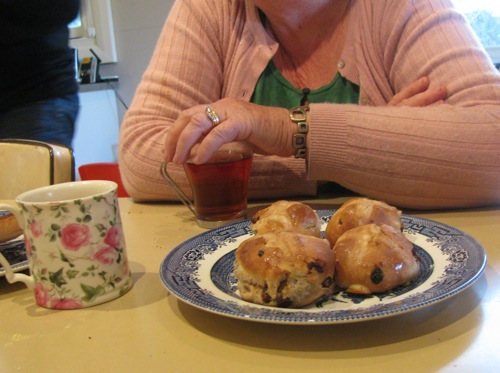
Tuesday, 26 April 2011

Buckwheat Nut Roast and Easter Reflections

As is our family tradition, we had Easter Sunday lunch at my mum and dad's place.  I took down a suitably celebratory buckwheat and sweet potato nut roast and a batch of marzipan choc chip cookies that I had made the previous day.  The house was groaning with all the food my family brought to the table.  When it comes to eating, we are wealthy, if not always healthy!

The nut roast was one that I have created for my Neb at Nut Roast event.   Ever since using buckwheat in a salad recently, I have been smitten with the groat.  It is so soft and nubbly.  My dad said it reminded him of sago (well actually he said it reminded him of the stuff like fish eggs and I thought he meant caviar but we worked out he meant sago).

I decided to make a GF nut roast because I also had some rice flakes that I wanted to use.  I have made a few gluten free nut roasts before.  As I cooked I thought of how nuts bring a creamy rather than nutty texture to most of my nut roasts.  Buckwheat groats bring a wonderful comforting softness that complements the nuts.  It doesn't harden up like rice or dissolve into mush like millet.

I must also give a nod in the direction of Ricki's Sweet Potato and Kasha Burgers (kasha generally referring to buckwheat groats).  While I still haven't managed to make them, they came to mind when I saw a few stray sweet potatoes in the fridge.  The sweet potato added moisture more than discernible flavour. 

The nut roast was a great success.  It can be cut in slices if you treat it gently but it will crumble rather more easily, as I found when I used up the leftovers (recipe coming soon).  I had it with roast potatoes and pumpkin, cauliflower cheese and peas, plus a spoonful of beetroot and orange chutney.  Fantastic!  E said it was one of his favourites of my nut roasts.  He loved the texture and flavours.  I found it quite strongly seasoned, but could not quite put my finger on why.

Dessert was a tyranny of choice.  GF Chocolate Cake with Raspberries (from this month's Australian Women's Weekly), trifle, pavolva, caramel tart, and caramel ANZAC tarts.  Possibly my favourites were the chocolate cake which I highly recommend and the tarts inspired by Matt Preston.  The latter were a timely nod in the direction of ANZAC Day which is so close to Easter this year.  My mum made her own ANZAC biscuits as the tart cases, made caramel out of a tin of condensed milk for the filling and topped them with some ganache.  Oh, so so so good!  Sylvia made a decent attempt at the piece of pav as well as sampling a couple of other things on the my plate.

I can't mention Easter without referring to hot cross buns.  My mum bakes them every year.  Above is a plate of her HCBs.  They were lovely, though we were so full from dessert that they didn't get a look in until supper.  I still have quite a few in my freezer too and am looking forward to making my way through them.

Easter also means eggs.  Not the kind that we get from these beady-eyed birds.  Chocolate.  You know.  The sort of chocolate that the factory has swept up off its floor and remelted into egg shapes.  Not my favourite way to eat the stuff though I have had a few.  Just to be sociable, of course.  Many eggs changed hands but are really for the kids these days.  We gave Sylvia some little eggs and it took three hours before I found her with half an egg in her mouth, complete with the wrapper.

The weather was just right.  Gentle autumnal sunshine.  Perfect for kids to play outside: kicking a footy about, spending hours on the swing, riding a tricycle or playing a spot of cricket.  Perfect unless you are Grace who was unlucky enough to get hit in the head with a cricket bat.  She was happier about the Easter egg hunt.  My brother Dave cunningly hid the eggs in the garden and the kids had lots of fun finding them.

Above you can see that my mum and dad's lemon tree is heavy with ripe fruit.  So it seems that this time of year is full as a state school.  Everything is happening within a week or two this year: Easter, E's birthday, ANZAC Day, a Royal Wedding and my blog anniversary.  Lots to tell you.  More soon.

Previously on Green Gourmet Giraffe
This time last year: NCR Very Garlicky Vegetable Soup
This time three years ago: Historic Cookbooks and Retro Gratin

Buckwheat and sweet potato nut roast
original recipe
serves 4-6

175ml buckwheat groats
385g sweet potato
1 tbsp olive oil (or less)
1 onion
3 cloves of garlic, crushed
1 baby carrot (or more)
1 cup finely chopped mushrooms (about 4)
1/2 cup ground hazelnuts
1/4 cup ground almonds
1 tbsp tamari
1 1/2 tsp bush spice marinade (or 1 tsp stock powder)
1/2 tsp smoked paprika
1 cup rice flakes (or oats if not GF)
1 egg (optional)
 cook for about 45 min on 180 until browned and firm to touch

Cook the buckwheat according to packet directions (I rinsed mine and simmered covered for 20 minutes in 350ml boiling water).

Prick the skins of the sweet potato and bake in a hot oven for about 1 hour or until soft.  You don't need to cool but it makes easier to take the skins off.  Peel and mash.

Perheat oven to 180 C.  Grease and line a loaf tin (mine is 13 x 22 cm) unless you are using a silicone loaf pan and even then a little baking paper in the bottom of the tin can help.  NB Silicone pans are good for transporting because you can keep it in the pan overnight or on a journey, and they also are good for reheating in the microwave.

Heat olive oil in a heavy based large frypan and fry the onion, garlic, carrots and mushrooms for about 15 minutes on a medium heat.  They should be fairly dry by the time they are done.

Mix cooked buckwheat, mashed sweet potato, fried vegies and remaining ingredients in a large bowl.  Tip into prepared tin.  Bake for about 45 minutes or until top is golden brown and the loaf is firm to touch.  Serve warm.  You can slice this but it is quite fragile and needs to be handled with care because it crumbles easily.

On the Stereo:
Am Himmel mit Feuer: Art Absconds

Monday, 25 April 2011

Why Does Food History Matter?

Dining room at Churchill Island, Victoria
‘Every vegetable has a history. … All have a tale to tell; all have incidents in their lives which reflect on humankind, on what we thought and felt, exposing our vanity and aspirations, our most intimate personal habits and beliefs, as revealing as any archaeological remains.’ Colin Spencer in The Vegetable Book

When most people tell us about a particular vegetable, they often talk about the nutrients, when it is in season, how to store and what to serve with it. But I want a broader picture. Since starting my food blog I have grown to love the stories about food. Which leaders have loved it, what poets have sung its praises, which cultural references has it influenced! As Colin Spencer articulates so beautifully, when we learn about food history, we learn about ourselves.

[Note: This is a long post with lots of resources for anyone (including myself) interested in food history.  I have been writing it off and on since 2008.  Over this time I have collected some photos of historic kitchens and quotes to add a bit of visual interest.  History seems a good topic for today's post, given it is ANZAC Day.]

'At that moment of tasting the mushroom, he had remembered home, and his mother, how their food was cooked and God knows what else about the place and then time in which he grew up.  Even in telling it, he was remembering both the eating of the mushroom and the memories they evoked.' Denis Cotter in Wild Garlic Gooseberries and Me (p 113)

Food is so much more than a fuel. It is comfort and company. It connects us to family, friends and culture. Food is a collective memory that bring our ancestors to life in a tangible way. It helps us remember a recent encounter, a childhood friend, a past civilisation. You only have to open a cookbook to see that history is integrally bound up with what we eat. Many food writers reflect on learning to cook with their mothers or grandmothers. Many recipes are named after people who gave it to us. We have a great need to know where we come from. Food helps to fulfill this need.

Treasury Museum, Melbourne
So much happens over food. The couple who lived in the above kitchen would tap morse code on their dinner plates when they wanted to say something they didn't want to hear. But mostly families have shared stories around the dinner table. Stories that become inextricably bound up with our food.  When I did oral history interviews for my thesis, I often found that a discussion of dinner gave an insight into people's lives. It tells us what life is like. For example this excerpt from my Great Uncle Des' letter during World War II give a sense of his day:

'Too bad the beer shortage hit over Christmas. Creamy soda made here is the best I could do but wasn't greatly worried as beer is only about sixth on my list of preferences these days. Some of the boys get stuck into their own brews of jungle juice - it's pretty potent stuff but so far I haven't tasted anything stronger than creek water, as bully beef can stir the old tummy up.'

Lord Kenneth Clark in Civilisation said that great artists are borrowers. So too are great cooks. They dig into the past and recreate it in ways that our peers recognise. A great example is Heston Blumenthal whose exciting creations rely on our memories of food. Michael Pollan says not to eat anything your grandmother wouldn't recognise but the best modern food has elements that she had passed down to us. Of course, my grandmother would not recognise all the "foreign" cuisines I now eat but someone else's grandmother might. I guess that counts!

Ripponlea, Melbourne
Food history and blogging
'Every time I knead a loaf of bread I am aware that generations of women before me have done the same thing, thinking similar thoughts, dreaming similar dreams, praying similar prayers.' Quoted at Baking Delights blog via The Leftover Queen

I love when past and present meet on food blogs. Here's a few excellent examples: Lucy shared her grandmother's cookbook, Lysy had a series of posts on Passover and all the symbolism beind the food during this period, Ricki often reminisces about the people and experiences behind that dishes she makes, and Kim wrote a wonderful evocative post about her family plot of rhubarb that brings her closer to her family.  Brydie wrote a lovely post comparing the food of three generations in Australia.

Cooking traditional recipes is imbued with memories of family. They guide and nurture us through recipes passed from generation to generation.  So it is that food bloggers remember important people in their lives by their recipes and their favourite food.  Here are a few blogs dedicated to the history of food:
Monsalvat, Melbourne
My food history

'Biscuits are one of the first things we learn to cook when we are little - or at least roll and stamp out, get the feel of, which is just as important - and there seems to be a sense in which we're recapturing some remembered, no doubt idealised, past whenever we make them in adulthood.'
Nigella Lawson in The Domestic Goddess

I recently sat at a family event eating caramel tart with my sister Fran. "I just can't eat it without thinking of Nan," she said to me. Yes a simple wedge of pastry and sugary filling can release a flood of memories of childhood meals around my grandmother's beige laminex kitchen table.

Nan would be wearing an apron and checking the scones in the wall oven. My little brothers and sisters would be whispering and shoving each other. Grandpa would be finding some old tram tickets or trinkets from a cereal packet that he had saved for us. Dad would be discussing family and friends with his parents. Mum would be helping. Probably cutting iced sponge cakes into thick wedges with cream oozing out of the centre. The table would be spread with all manner of sweet treats: lamingtons, caramel tart, sponge cake with passionfruit icing, pineapple delight etc etc. After lunch I would sit in Nan's sewing room sitting on the well stuffed divan with my legs not touching the floor. I admired her cheval mirror as I flicked through her magazines and dreamt of creating the recipes.

It is not only my Nan who is linked to food in my memory. My mum always made a batch of mince pies to take to her father. I can't eat a liquorice allsort or a macaroon without thinking of my Grandpa. In fact one of my favourite stories is his horror at my Nan's "deviousness" when he discovered she had substituted margarine for butter after his heart attack. One of my early memories of my maternal grandmother in my mum's childhood house is of her sitting stirring a bowl of chocolate pudding by hand.

Motts cottage, Port Fairy
Food has been a way to nurture and love. Mum remembers her maternal grandmother, who always had a kitchen table full of baking when they visited. She baked apple slice, scones and sponges and never sat down because she was too busy bringing food to her family. They didn’t sit in the kitchen where she baked but in another room. My mum regularly makes apple slices, scones and sponges. It is a nice connection.

Of all of these I love scones most. I not only make scones a lot but it is one of the last things I remember my maternal grandmother baking for me - with home made strawberry jam. E too remembers the women in his family making many wonderful baked goods, especially treacle scones. A scone can mean many things! 

My childhood was full of cooking. Baking with my mum. Licking the beaters.  Pushing two fingers into risen bread dough to see if it sprung back.  Sitting around the family table sharing meals, trying to sneakily watch the telly at the same time, talking about our day. School lunches. Learning to cook in the home economics kitchens at school.

Finding out that not everyone ate like us. I remember my surprise at being offered a biscuit for "afters" or "sweets" because I was used to hot cooked desserts at home. Some kids were even allowed to have as much milo as they liked in their milk! Others got biscuits with funny faces made of lollies.

I've written a lot in my blog about food of my childhood and food history, so you can read more in these posts:
Kitchen at Churchill Island, Victoria
More food history on the web

'I have a lot of old cookbooks myself... But the really old ones (dating back to medieval times) are in online databases. Over the last few years there has been an explosion in the number of historic cookbooks that have been made freely available over the Internet, thanks to such organisations as Google Books, Gutenberg and the Internet Archive, as well as a lot of libraries around the world.'
From 2010 interview with Janet Clarkson aka blogger behind The old foodie

It will be clear from the above lists that I have taken quite an interest in food history since starting this blog.  Most, but not all, of my research is done online.  I have been fascinated to find just what a wealth of information is available on the humble internet.  Did you know that the IVU have a list of historic online vegetarian cookbook - mostly from the Nineteenth Century - that you can download in their entirety?  Were you aware that you can find where many foods came into use on the Food Timeline? Would you like to be a virtual tourist and visit an even online food museums such as the Carrot Museum?

It is amazing what you find when you put a topic into a search engine.  It can also be frustrating.  So to help you out - and remind me - here is a select list of some of the sites I have found useful when searching for information about food history.  Of course, these are only the tip of the iceberg.
Stamps from Australia featuring Australia's iconic recipes.
Food history offline

"It is curious how seldom the all-importance of food is recognized. You see statues everywhere to politicians, poets, bishops, but none to cooks or bacon-curers or market gardeners."  George Orwell in The Road to Wigham Pier

If you walk into my favourite food book shop Books for Cooks in Gertrude Street, Fitzroy and look for books on food history, you will be overwhelmed by shelves of them. It is a topic of endless fascination.  Nostalgia is never goes out of fashion.  However you will find that it is not limited to books focused on the topic.  All manner of histories and memoirs (including George Orwell's) have choice bits that give an insight into food in our lives.  Cookbooks too are often a great source of history.

Food history is found in more places than books.  Museums usually have information about food.  I particularly love all the old food posters.  The built environment will yield information about food history.  The faded old painted advertisements on the sides of buildings are few and far between now but they always seem quite dignified to me compared to their flashy billboard counterparts of today.  Some of our food institutions preserve some of the traditions of the past: the Queen Victoria Market, the Hopetoun Tea Rooms in the Block Arcade in the city, and The Windsor Hotel's high tea, to mention just a few.  Films such as Julie and Julia or Babette's Feast also explore changing attitudes to food.

Much food history is unseen.  One of my favourite assignments as a student was a history of market gardens.  There was very little architecture left but it gave me a fascinating insight into just how some of our Melbourne suburbs were used, not so long ago.  Even our houses carry their own histories.  If only the walls could talk, imagine the food that might have been cooked in our kitchens before us.  One of my favourite food history stories is of members of the Ephemera Society who saved a bread roll from Pope Paul VI's visit to Melbourne in 1970 and nailed it to the wall.

Old advertisement for Bushells tea - Park Street, North Carton
It seems a bold move to attempt to give a select list of all the books focusing on food history but below are a few that I have found useful and enjoyable.  I own most of these books and still plan to get my hands on a few.  If you wanted to read about food history, you could do worse than starting with this list.
Retronyms

One quirky way of reminding ourselves of how much our approach to food has changed over the past few generations is the humble retronym. A retronym relates to terminology that has been created to differentiate new concepts from old ones. Foodie examples of this include: free range eggs, fruit in season, real ale, unsliced loaf, unpasteurised milk organic fruit and vegetables, vine ripened tomatoes, cold water tap, conventional oven, full cream milk, whole meal (whole wheat) flour, corn on the cob, plain flour, all purpose flour, tap water.

A vintage sign in Brunswick, Melbourne. 
I don't think Peters ice cream would get away today with claiming ice cream was the health food of a nation. I guess things were different way back when!
Why does food history matter?

History must be protected.  Why?  People need connections.  They need to know where they came from.  I partly say this to myself as a food blogger.  Blogging has sent me off in search of the new.  I delight in innovation.  Recipes that I used to make over and over are no longer so frequently seen in our kitchen.  I don't want to lose sight of the old because I am dazzled by the new.  However, the blog has also given me space to reflect on why some of my traditional recipes are important to me.  So I thought I would write a list:
  • History is a great teacher.  Look at how our foremothers made it.  They often have insights and tips to pass down to us.  Many recipes have generations of learning in them.  We don't always need to be reinventing the wheel.
  • History recognises diversity.  Barbara Kingsolver in Animal Vegetable Miracle really made me think about how dreadful it would be to lose the diversity of vegetables and fruit.  What a dull world it would be that didn''t recognise different tastes as well as different geography.
  • History can made sense of our lives.  I have read about vegetables changing over the years.  such as , eggplants becoming less bitter so they don't need salting.  I was also fascinated to read that Americans use cup measures because scales were not reliable in the past.  History explains why condensed milk was necessary and not just a sweet treat.
  • History recognises geographical differences.  In the world of the interwebs, it seems that we are one big happy family.  Yet coming from Australia, I am aware of how many differences there are in our cuisines to our British and American cousins.  It is important to keep our culture strong in cooking to remember where we come from.
  • History appreciates aesthetics.  Our foremothers appreciated the need for food to be pretty, to tempt, to celebrate.  They created traditions that are still a sight to behold today.  A flaming Christmas pudding.  Ruby coloured jams.  Wobbly plates of jelly.  Even the names of dishes hold an old world charm.  Toad in the Hole.  Spotted Dick.  Knickerbocker Glory.
  • History nourishes the soul.  Food is about more than nutrients.  It is nursery suppers and nostalgia. It is comforting because it reminds you of your mum's hot cup of soup on a cold night, or flat lemonade when you were sick, or warm tea cake on a lazy afternoon.  Food from our past reminds us of love and care.
    • History is fun.  It is fetes and festivals.  It is barbecues and banquets.  It is quaint and quirky.  It is remembering our childhood dishes that made us smile, the treats our grandparents bestowed upon us, the lolly bags we took home from kids parties. Our foremothers made food to please and tempt and wheedle.
    • History knows how to cope.  It surprised me to find that there is a long history of vegetarian food.  We are not the first to find ways to eat without meat, or in times of poverty, or when items of food is scarce.  Our ancestors knew a lot about eating locally and frugally.  We can learn a lot from them.
    • History puts life in perspective.  It reminds us that others have also failed or succeeded in recipes.  We are not the first to have a sponge sink on us and continue to bake them until they are fluffy as a cloud.  Reading about the shortages during war, makes me feel grateful for the abundance of food we can buy locally.  Even being able to buy a carton of milk seems like a luxury compared to having to milk the cow.
    'I cooked with my mother, I leafed through her cookery book collection and appreciated great prose, I helped in the garden, I listened to her explanations of a dish or a meal, I gloried in her special dinners complete with fancy touches from the garden or carefully-chosen plates, and I came to understand that an interest in the food of the world meant an interest in the culture of the world.'
    Stephanie Alexander writing about her mother (online)

    Saturday, 23 April 2011

    Marzipan choc chip cookies

    I've been thinking about marzipan a lot ever since Choclette announced it the theme for April in the We Should Cocoa event that she holds with Chele each month.  At first I thought it was my opportunity to make the Green and Black's Chocolate Stollen that has been on my to-do list for years.  Then I was honest with myself about what I could do and decided to make cookies instead.

    I have also long desired to make my own marzipan.  That opportunity wasn't going to go by the wayside.  I had seen Suelle's Marzipan stuffed Chocolate Biscuits a while ago.  Then I stumbled across a vegan version in the recipe for Marzipan Filled Pillows from The complete guide to vegan substitutions (p 90) by Celine Steen and Joni Marie Newman.  I love their work but I didn't have potato starch to make the marzipan and the 240g chocolate for 8 cookies seemed a tad excessive.

    I did remember Lucy's homemade marzipan that she made a few years back.  It had impressed me because it used so little sweetener and no eggs.  I didn't have the almond essence and I found I needed to use more rice malt syrup than her.  Nevertheless, when Sylvia tasted it, she was quite positive about it.

    I was intent on making marzipan stuffed biscuits until I found a recipe for biscuits with choc chunks and marzipan chunks.  Then I realised that while fancy biscuits are fun, choc chip cookies are what we love in our house.  They are both easy and delicious.  I got out my favourite choc chip cookie cookbook and chose a recipe to adapt.  I substituted marzipan for walnuts and coconut.

    How did they taste?  Let me put it this way.  These are the sort of cookies that are best when out of sight, out of mind, because, if you remember just how good they taste, you want another.  I can't claim that they taste very strongly of marzipan.  I don't have any almond essence, which may have made a difference.  The cookies are so buttery and full of chocolate that they can't fail to please.  Yet I think the marzipan adds great texture to the soft chewy centres. I would like to try them with almond essence but am afraid I would ruin this perfect combination.

    Sylvia and I had a lovely time making these.  She did a great job of pouring and stirring but her biscuit-forming skills need some honing.  The cookies were delicious warm from the oven.  Sylvia wanted a taste but I didn't want to spoil her dinner - not that she ate any.  We are taking some of them down to Geelong tomorrow.  They seem a good offering for Easter Sunday.  Maybe Sylvia will get her taste there.

    Previously on Green Gourmet Giraffe
    This time last year: Grumpy's Green - well fed with eco cred
    This time three years ago: ANZAC Day and the Biscuit Police

    Marzipan choc chip cookies
    adapted from The search for the perfect choc chip cookie (p 40)
    makes 3-4 dozen (I made 38)
    • 1 cup plus 2 tbsp plain white flour
    • 1/2 tsp bicarbonate of soda (baking soda)
    • pinch salt
    • 1/2 cup castor sugar
    • 1/4 cup brown sugar (not packed)
    • 1 egg
    • 1/4 tsp vanilla extract (optional)
    • 120g butter, melted
    • 1 cup dark chocolate chips (or less)
    Marzipan:
    adapted from Nourish Me
    • 1 cup (100g) ground almonds
    • 3 tbsp rice malt syrup
    • 1/4 tsp almond extract (optional)
    First make the marzipan:  Mix ground almonds, rice malt syrup and almond extract (if using) in a small bowl.  Press together in a ball and knead briefly (I just squished it a bit in my hands).  Make into a long log, wrap in cling film and place in the freezer while you start on the cookies (I think mine was there about 30 minutes).

    To make cookies: preheat oven to 200 C and line a large tray (or two medium ones) with baking paper or silicone mats.  Mix flour, bicarb soda, salt, and sugars in a medium to large bowl.

    Take the marzipan out of the freezer and using a floured board, chop into small chunks.  I found mine was very sticky so I cut it into thin strips and sprinkled a bit of flour on these so they didn't clump together when I chopped them.  Add egg and melted butter to the flour mixture.  Then stir in the choc chips and marzipan chunks.

    Take teaspoonfuls of the mixture and form into small disks on the prepared tray.  If you have lots of stray choc chips like I did, just press them into the disks.  NB I found mine didn't spread too much.  Bake for 8-10 minutes until just starting to brown around the edges.  Better a little underdone than overdone.  Rest on tray for about 10 minutes and then remove to a wire rack to cool.

    On the Stereo:
    Brood: My friend the chocolate cake

    Friday, 22 April 2011

    GF Tim Tams, Hot Cross Buns and Haggis Pizza

    Greeting on this Good Friday.  Although we call it "good" Friday, it doesn't seem appropriate to say happy Good Friday.  It is a day for quiet and reflection so it seems a day for a rambling post about the week.

    GF Tim Tams

    I made a batch of GF Tim Tams on the weekend for E's birthday lunch.  If you are not Australian, Tim Tams might not mean a lot to you but there they are a beloved chocolate biscuit (cookie to the Americans).  They are similar but not the same as Penguin biscuits in the UK.  In fact the Tim Tam was based on them.  The Tim Tam was named after a race horse and has given rise to the popularity of the strange tradition: the Tim Tam Slam.

    A few months back, Lisa tried her hand at GF Tim Tams.  I was determined to try them out for my celiac sister and niece.  When we decided to have the family around for E's birthday, it seemed the right opportunity.  Now I don't actually eat a lot of Tim Tams, now that I can.  When I was young I yearned after them but my mum made her own bikkies.  It's a case of the grass being greener over the other side of the fence.  So I knew my sister, Susie, would love to eat one.  Grace, my niece, on the other hand has been celiac since she was about 2 years old and has no memories of food with gluten.

    I regret to say that my GF Tim Tam experiment was not the success I'd hoped it might be.  I followed Lisa's directions and have written an approximate recipe below.  After reading the ingredients of the Tim Tam I modified the filling a bit, using chocolate, butter and a little golden syrup, rather than cream and chocolate spread.

    All went well until I unwisely substituted butter for coconut oil and consequently my chocolate was too thick to dip properly.  After talking to my mum, I assume this was why the melted chocolate didn't thin as it should.  But doesn't chocolate always melt into a liquid rather than a thick sludge (albeit a tasty sludge)?  Even when I microwaved it more to make sure it was hot enough, it just got thicker - and it didn't help to add more butter either.  Ironically when I melted equal parts of chocolate and butter for the filling, it was far too liquid for my needs.

    Nevertheless, Susie was delighted.  There is so much chocolate and butter in the recipe that it can't taste too bad.  I wondered if the gluten free tea biscuits were too crunchy.  They are great biscuits (excellent for grubs and hedgehog) but didn't yield when bitten so the filling would ooze out the sides.  I found one other Tim Tam recipe online which included a recipe for chocolate biscuits but not GF.  Makes me think that maybe if I was serious about the recipe I could make some biscuits.  The bought ones make it far easier though.  I feel I have made a good start and will let you know if I attempt them again.

    Haggis Pizza

    When I told Sylvia that I was making Pizza for dinner during the week, a big smile lit up her face.  It was on the actual day of E's birthday.  A few weeks back he had told me that his family in Scotland had eaten haggis pizza for dinner.  It sounded easy enough to make at home.  I told him I would make it for his birthday.  It was not difficult but it was time-consuming.  Fortunately I made it on a day I wasn't working. 

    I am not giving a recipe here because it is merely a matter of bringing together recipes I have previously posted.  I made wholemeal mashed potato pizza bases, spread on some tomato sauce like this one (but with zucchini and carrot), sprinkled on some of this vegetarian haggis.  I had meant to mash some neeps (turnip in Scotland aka swede or rutabaga) to make it a haggis, neeps and tatties pizza.  But I was running out of time.  Instead I remembered I had forgotten to add mushrooms to the haggis, so I sprinkled some chopped mushroom and capsicum, and grated some mozzarella cheese on top.

    This was a success!  We loved the haggis on the pizza.  It was tasty, full of texture and nutrients.  I even managed to make a nice green side salad.  Sylvia didn't have haggis on hers but she loved helping to sprinkle (or dump) the toppings on the pizzas. We now have some leftover haggis that I think might become nachos for when we watch Will and Kate's wedding.

    Hot Cross Buns

    I made a birthday cake for E on the weekend (to come soon) and an apple cake to take to a friend's so I didn't make an extra cake on his birthday.  Instead, we had a special birthday Hot Cross Bun (see pic at top of the post).  I am not a huge fan of all the substandard chocolate in easter eggs but I love hot cross buns (HCBs) and have been baking them every year for some time.

    This year I added a bit of wholemeal flour to the HCBs which worked well.  My major crisis point was also my epiphany.  It came when I found I was out of the baking paper I usually use to make a disposable piping bag for the crosses.  In seeking alternatives, I found that filling a plastic bag with batter and snipping a hole in the corner is a lot easier way to pipe crosses.

    It has also been pleasing this year to see that my recipe worked well for vegan bloggers, Mel and Danni.  But I am surprised they don't make them with crosses.  I make my crosses thick and chewy because I love them. So I thought I would find out a bit more about why we have crosses on our buns.  The obvious answer is that they represent Jesus Christ dying on the cross.  Yet there is often more to a Christian ritual.  In this case, the crosses are believed to have be marked on buns by Saxons in honour of the goddess Eostre, and that the crosses represent the four quarters of the moon.  You can find out more about the history of Hot Cross Buns at Historical Foods or read Oliver Thring Consider the Hot Cross Bun History.

    I have enjoyed some hot cross bun posts this year:
    Other Food

    We have had other food this week.  Bangers & mash,  stir fry, dumplings, fruit balls.  I tried a fig and raspberry smoothie that didn't quite work.  I added spinach but it needed banana for the right texture.  It didn't help that my hand held blender needs to be replaced.  I might have done so this week if the shops weren't so horribly busy.  Instead I used my food processor which just wasn't the same.

    E opened an easter egg this afternoon but there hasn't been too much chocolate after the GF tim tams.  We did buy one trashy treat that delighted E because it was just the sort of thing that his mum would buy for him: Cadbury's mini eggs chocolate nest cakes.  Soft chocolate cake with butter cream and easter eggs on top.  No nutritional value but lots of comfort and seasonal cheer.  If you like this sort of thing you might enjoy this ode to Cadbury creme eggs.

    Lastly, I thought I would share a few Easter recipes that I have seen on blogs lately.  So many good ideas for alternatives to Easter eggs.
    Previously on Green Gourmet Giraffe:
    This time last year: Cookbooks update and easy roast dinner
    This time two years ago: WTSIM ... Retro Parkin
    This time three years ago: HoTM French Toast with Fruit

    GF Homemade Tim Tams (Work in Progress)
    adapted from Bike Bake and Blog
    makes about 14

    100g milk chocolate
    100g butter
    1 tsp golden syrup
    1 packet of Freelicious gluten free tea biscuits
    400g milk chocolate, for dipping
    1 tsp coconut oil

    Place chocolate, butter and golden syrup in a heatproof bowl and melt in the microwave (or on the stovetop if you prefer).  Sit in the fridge until sludgy rather than liquid - I think I left it there about 30 minutes but more would be better.  Beat with electric beaters to fluff it up a little.

    Lay half the biscuits on a lined tray.  Divide up dollops of the mixture evenly between the biscuits.  Place the remaining biscuits on top of each dollop and press down gently.  Place in the fridge for 1-2 hours to firm up.

    Once biscuits are cool, melt dipping chocolate and coconut oil until smooth and runny (see notes about about my troubles with this).  Use a couple of forks to dip in each biscuit sandwich.  Return to lined tray and sit in fridge to firm up.

    On the Stereo:
    The Collection: ELO

    Tuesday, 19 April 2011

    Roasted Cauliflower and Pumpkin Salad

    Saturday was crazy.  My hand held blender died while making a smoothie.  I went to the supermarket three times.  We fought our way past children watching the easter bunny in the mall.  I came home without donuts which were sold out and without falafels because the wait was too long.  Sylvia wouldn't sleep.  She told me she had to do a few things and proceeded to throw things out of the kitchen drawer.

    I drove to another shopping centre and circled endlessly in search of a parking spot.  I was so frazzled I took the escalator to the wrong level of the department store.  A fortuitous mistake.  There was the fruit bowl I had coveted.  On sale!  Something had to go right.  Then I forgot things at the supermarket and had to stop at another on the way home.

    We had a few people over for E's birthday on Sunday.  Saturday was full of preparations.  My mum took Sylvia to her house for a sleepover.  I was able to do so much more without her about but it was odd.  No little face tilting to the side with the question "are 'ou ok, mummy".  No little hands tipping jigsaw puzzles over the rug.  No little arm being curled around Zinc's neck in a cuggle.  No little gruff voice making us laugh.  No little belly needing filling at the end of the day.  No little eyes being rubbed as sleep beckoned.  Very odd.

    E wanted to order pizza.  I was tempted.  Then I remembered I had eaten enough toast and hot cross buns that day.  I needed vegetables.  A cauliflower and a wedge of pumpkin the fridge called to me.  I chopped them and roasted them, using a marinade for the pumpkin.  I added some vegetables, a squeeze of lemon juice and a generous dollop of yoghurt.  E would have preferred pizza but the salad was what I needed.

    The dressing was quite intense, dark and thick.  It worked better with the warm vegetables than in the cold leftovers the next day.  I made more than is in the recipe.  There is still a little in the fridge.  I used a spoonful of leftover dressing in a stirfry today to add some depth of flavour and it made a nice contribution.  I might try it with other spice mixes in future.  A nice piece of experimentation.

    Previously on Green Gourmet Giraffe:
    This time last year: Curried Paneer and Birthday Cheer
    This time two years ago: Tempting prune cake
    This time three years ago: NCR Moody Mushroom Stew

    Roasted Cauliflower and Pumpkin Salad
    serves 2-3 as a main meal

    Marinade:
    • 1 tbsp bush spice mix (or a little less)
    • 1/4 tsp smoked paprika
    • 1/4 tsp garlic powder
    • 1 tbsp maple syrup
    • 1/2 tsp seeded mustard
    • 1/2 tsp chilli paste
    • 1 tbsp olive oil
    Salad:
    • 1 tbsp olive oil
    • 1 head cauliflower
    • 800g pumpkin
    • 60g (handful) baby spinach, chopped
    • 6 cherry tomatoes, quartered
    • 1 spring onion, finely chopped
    • 1 cup cooked white beans
    • juice of half a lemon
    • 2 dessertspoons of yoghurt
    Make marinade by lightly whisking all ingredients in a small bowl with a fork.

    Chop cauliflower into largish florets and toss with 1 tbsp olive oil and a pinch of salt in a large roasting dish.  Trim, peel and dice the pumpkin.  Place in another roasting tin and toss in the marinade.  Roast cauliflower and pumpkin for about 1 hour at 200-220 C (I can't quite be exact with temperature as I changed it a few times).

    While the vegies are roasting, place the spinach, tomatoes, spring onion and beans into a large salad bowl.  When cauliflower and pumpkin are cooked through (prick them with a fork to check - a bit of char is fine), tip into salad bowl.  Squeeze lemon juice over vegetables.  Spoon yoghurt over the top.  Stir until salad is evenly coated with yoghurt.  Serve warm.

    On the stereo:
    The best of: Bob Dylan

    Sunday, 17 April 2011

    Autumn Apple Cake

    Last weekend (unlike this one) was a lazy weekend.  I had it in my head to make apple cake.  There were a few contenders.  The oats and spices of Lucy's Spicy Autumn Apple Cake won me over in the end.  Sylvia now jumps on a chair to help whenever I am cooking.  She loved making the apple cake with lots of interesting ingredients, lots of stirring and lots of pouring.

    Cooking with children is a joy though it brings its own problems.  Little hands are quick to shove apple and uncooked oats in the mouth.  I might get distracted and tip a bit of coconut into the cake mixture before remembering it is destined for the streusel topping, or confuse half cup with third cup measures as we made the streusel topping.  A fork was plunged into the unbaked cake as we were spreading the streusel mixture on the cake, and handfuls of mixture were thrown onto the cake rather than evenly scattered.  All worthwhile when the little voice says "I like apple cake". 

    This is a cake with dried fruit that becomes plump when infused with hot tea.  There is no eggs or butter or oil in the cake.  The only butter or oil is in the streusel.  Lucy used butter but suggested oil as an alternative.  I used the latter.  It was a lazy weekend.  Not a day for the hassle of melting butter.  The streusel was crumbly and fell off the cake easily.  The cake was dense with the dried fruit being more prominent than the apple.  Not the cake I had expected.  Great comfort food, nevertheless.  Maybe next time I will try it as muffins or even make this apple cake that also tempted me.

    Sylvia's favourite bit was the crumble.  In fact, she loved to reduce a whole piece of cake to crumble.  E was looking after her on Monday.  While he turned his back to do the dishes, little hands dug into the crumble.  Behind the cake below you can see Sylvia's new Bagpuss annual that arrived in the mail the same day.  Unfortunately the pages fell out upon inspection.  Not as much fun as making cake!

    I am sending this cake to Anh of A Food Lover's Journey for this week's Weekend Herb Blogging #279, the event coordinated by Haalo and founded by Kalyn.

    Previously on Green Gourmet Giraffe:
    This time last year: Fruits of Autumn: figs, rhubarb and walnuts
    This time two years ago: Curried Cauli, Spinach and Peanut Soup
    This time three years ago: Family Favourite: Chocolate Pudding

    Apple fruit cake
    slightly adapted from The Kitchen Maid
    • 1 1/2 cups hot tea
    • 1 1/2 cups dried fruit (I used about 1/2 cup raisins, 1 cup chopped prunes)
    • 1 cup rolled oats
    • 3/4 cup loosely packed brown sugar
    • 1 tbsp golden syrup (or use maple, or date syrup)
    • 1 cup peeled, diced apple (about 2 medium apples)
    • zest of 1 lemon
    • 1 cup wholemeal flour
    • 1 cup white flour
    • 1 tsp allspice
    • 1 tsp cinnamon
    • 1 tsp ground ginger
    • 1/4 tsp nutmeg (preferably a good grinding of a whole nutmeg)
    • 1/4 tsp bicarbonate soda
    • 1/4 tsp salt
    • 2 tsp baking powder
    Crumble topping:
    • 1/3 cup oil
    • 1/2 cup each rolled oats
    • 1/3 cup coconut
    • 1/4 cup wholemeal flour
    • 1/3 cup walnuts, crushed with a fork
    • 1/4 cup brown sugar
    • 1 tsp cinnamon
    Put the raisins, rolled oats, golden syrup and brown sugar in a large bowl and cover with hot tea.  Stir and cool to room temperature.  Or not quite cooled if you are impatient like me.  Add in apple and lemon zest.

    Preheat oven to 170 C and grease and line a 24cm springform cake tin.  (I only have a 22cm tin so I used that and a little ramekin).

    Make the streusel topping by mixing all ingredients together.

    Add remaining ingredients to apple mixture. Stir gently until all is combined.  Tip into prepared tin.  Evenly scatter streusel mixture over the top.

    Bake for about 40 minutes until a skewer comes out cleanly (I think it took me longer).  Cool in the tin at least 10 minutes before releasing the springform sides.  Ours lasted about 4 days and was better when completely cooled to room temperature.

    On the stereo:
    The BBC Sessions: Belle and Sebastian

    Friday, 15 April 2011

    NCR Tricken Rice Soup with Celeriac

    Tonight's soup brings up many mysteries such as chicken soup, stock, celeriac, children's diets, translating meat dishes into vegetarian versions.  I don't know what to tell you first.  That chicken soup has such a great reputation for being comforting and restorative that it even appeals to vegetarians.  That Sylvia wanted to go shopping for tofu this morning but cried when she tasted a piece of tofu from the soup.  That celeriac and fried tofu gave this dish some of the richness that a vegetarian seeks without the need to turn to meat.

    The best seller Chicken Soup for the Soul gives an indication of how important chicken soup is considered in some cultures.  It is not just about the chicken.  It is about a full-bodied yet undemanding nourishing broth.  It often seems to be about nostalgia for a nurturing relationship and a cure for all manner of ailments.  For me, it is the sort of soup that I want to eat in these cooler Autumn evenings.

    For vegetarians, there is the challenge of making a soup which is centred around a carcass.  I am not the only vegetarian to be fascinated by chicken soup. Many others have trodden this path before me.  Susan, PPK, Erin, Mollie and Lindsay are just a few to share their versions.  They use matzo dumplings, noodles, chickpeas and special seasonings.  I have started to buy fried tofu puffs occasionally and thought they would do the trick.

    Despite the vegetarian recipes out there, it was Katie's Chicken Rice Soup that inspired me.  I had to wait until the weather cooled to try it, but it has been niggling at me ever since I saw the recipe at the start of the January.  Once I tackled it, I changed the recipe beyond recognition. I increased the vegies as well as using fried tofu.  I was particularly pleased with the addition of celeriac.  Often I don't know what to do with this strange knobbly vegetable but it seemed just right in the soup.  I forgot about Katie's addition of mustard and cornflour.  Maybe next time.

    Katie's recipe directed me to make stock first and then the soup.  Most chicken soup recipes call for the simmering of a carcass to make stock and then the adding of a shredded chicken.  However vegetables do not seem to need to simmer as long as meat.  So it is a mystery to me as to whether vegos need to make a separate stock for such soups.

    When I make a soup that is full of flavoursome vegetables, I feel that some salt and a bouquet garni of herbs from the garden is all the extra seasoning that is needed.  Though I did wonder if some stock would have given depth of flavour.  I have a bag of vegie scraps in the freezer to make into stock when I have some time.  They include the scraps of purple carrots which I didn't think would give the soup the right look.

    I need not have worried about the stock.  E and I were very impressed with it.  The combination of  a bit of chewy tofu, nubbly rice and soft vegetables was just right.  The broth was full of sweet vegetable flavour that needed seasoning to turn it into a savoury meal.  The soup was satisfying without being heavy.  Sylvia wouldn't eat it despite loving rice and tofu.  She will share some of our meals but draws the line at soups and stews, not even convinced by the Soup Dragon in her favourite tv program the Clangers.

    While eating the soup, I asked E if his mum had made chicken soup for him as a boy.  I can't remember my mum doing so, though I do remember her horror when I mistook a pot of stock for dishwater and threw it down the sink.  E remembers what he calls his mum's "famous broth" that she made with chicken bones and the family loved.

    It was an evening full of nostalgia.  Not only did we reminisce over dinner but we followed it by watching Turn Back Time: the High Street.  We only got hooked towards the end of the series, unfortunately.  It was fascinating the way it looked at the British high street in six different decades and how it has changed.  This week was the 1970s.  E loved seeing some of the food he had used to eat (Vesta, Angel Delight, etc).  The shops made him remember Easy Rider (his favourite record store in Forrest Road, Edinburgh) and the Pakistani convenience store opening up near his Granny's house.  Ah, memories!

    I am sending this to Jacqueline for this month's No Croutons Required (an event run with Lisa).  She has chosen a fun birthday theme (check it out) to celebrate her own birthday. My soup fits with the nourishing soup and rice themes.

    Previously on Green Gourmet Giraffe:
    This time last year: Honest soup inspired by a Farmers Market
    This time two years ago: Easter Nut Roast and Feasting
    This time three years ago: The Nut Roast in History

    Tricken Rice Soup with Celeriac
    inspired by Thyme for Cooking
    serves 5-6
    • 1 tbsp olive oil
    • 2 onions
    • 2 stalks celery
    • 3 large carrots
    • 4 medium parsnips
    • 1 celeriac
    • 2-3 cloves garlic, finely chopped
    • 8-10 cups water
    • 1 tsp salt
    • bouquet garni - I used bay leaves, thyme, rosemary, parsley (and would have used sage if I had it)
    • 180g fried tofu puffs, chopped
    • 3/4 cup rice (uncooked)
    • seasoning, as required
    • chopped parsley, to serve
    Heat oil in large stockpot.  Trim, peel and dice vegetables and add them to pot as you chop them, stirring occasionally to prevent them sticking to the bottom of the pot.  I prepared them in the order that I have listed them.  Stir garlic into vegetables for a minute or two.

    Add 8 cups of water, salt and bouquet garni.  Bring to the boil and simmer for about 20 minutes until vegies are soft.  Throw in tofu.  At this point I left it overnight, but that is optional.  Add rice and simmer for about 15-minutes until it is cooked.  Add more water if needed.  Remove and discard bouquet garni. 

    Check seasoning.  Mine benefited from some more salt and black pepper.  Ladle hot soup into bowls.  Serve with a sprinkling of finely chopped parsley.  Soup keeps well for 2-3 days but the rice will absorb a lot of the water.

    On the stereo:
    The Bells Shall Sound Forever: a tribute to Current 93: Various Artists