Wednesday, 30 April 2008

Bugs Bunny, Daleks and Carrot Paté

Q. What’s a wok for?
A. To throw at a wabbit when you don’t have a wifle!

Today is that wascally wabbit, Bugs Bunny’s 70th birthday. Like many of us, I spent many hours as a child laughing at Bugs jokes like the one above. So to celebrate I thought it was time to post about the carrot paté I made last weekend. Though I don’t know that Bugs would appreciate his carrots mashed with tofu and baked. Nor do daleks according to E. The paté froze solid in my fridge in the dalek lunchbox. Maybe if you had opened my fridge you might have heard cries of ‘exterminate, exterminate!’ (If you want to see the lunchbox, you can see a photo here.)

But one person who does love a bit of tofu is Ricki. It was her recipe I used for the paté. I have never made a baked paté but thought that hers looked like such a firm and colourful loaf that I have been wanting to try it ever since I saw it. So I was surprised when it came out of the oven and was light and soft like a mousse rather than dense and stodgy as I expected. Once I got over my disorientation with the texture, I really enjoyed it. I used fresh thyme as well as parsley and the herbs gave a pleasing flavour.

It has been delicious on toast for breakfast, lunch and dinner. I had intended to serve it for dinner with salad but the weather has gotten so cold lately I had to serve it with roast veggies and leftover nut roast instead. It is a summery dish so I intend to try it again in warmer weather when I want something light and tasty with a salad.

Carrot and Tofu Pâté
(adapted from Diet Dessert and Dogs)

450g (1lb) carrots
2 tbsp (30ml) olive oil
2 tbsp (30ml) cider vinegar
2 tbsp (30ml) white miso
1 tbsp fresh thyme (or ½ tsp dried)
300-400g firm silken tofu
2 tbsp (30ml) cornflour (cornstarch in the USA)
1/2 cup (120ml) chopped fresh parsley or coriander

Preheat oven to 170 C (325 F). Grease a small loaf tin and line with baking paper. My loaf tin is 13 x 22 cm and the loaf was quite a lot flatter than Ricki's so I think she must have quite a small tin.

Cook carrots in lightly salted water until tender. Drain (Ricki says to cool but I didn’t). Puree carrots in a food processor. Add remaining ingredients and process until completely smooth.

Pour into the prepared loaf tin and bake for 50-60 minutes or until a skewer inserted in the centre comes out clean.

Cool in the tin for at least 4 hours or overnight. Turn out onto a platter to serve. Serve with bread, dry biscuits or rice crackers. Beware the dalek lunchbox for storing leftovers!

On the Stereo:
Donec Ad Metam: Various Artists

Tuesday, 29 April 2008

Green Gourmet Giraffe Birthday Cake

A year ago today I started my blog with a Vampire Cake that I made for E’s birthday. This year he shared his birthday cake with my blog and it had to be a Green Gourmet Giraffe Birthday Cake!

I thought it was the right moment to share how I came up with the name of my blog: Green is a favourite colour because it is so cheerful and hopeful. It also signifies green politics that encompass vegetarianism, feminism, environmentalism and social justice movements. Gourmet was inserted into the title because I like alliteration and I wanted it clear that it was a food blog, although I don’t believe much of my cooking is terribly gourmet! I did a school project on the gorgeous, gracefully gangly Giraffe when I was 7 years old and have been fascinated by them ever since. Unfortunately I have lost the booklet I did but I can assure you my pictures were quite amusing. The giraffe is the tallest land-living creature and has a deadly kick and a tongue long enough to clean its face. They are mute, require 1.9 hours sleep on average a day and are quite vulnerable to lightning. Being tall has its drawbacks! They always seem so peaceful and gentle at the zoo, and I am sure would make a lovely pet.

So it seemed fitting - and fun - to make a green giraffe cake to celebrate a year of blogging. I love my novelty cakes. This cake comes from the esteemed Australian Women’s Weekly Children’s Birthday Cake Book. Of course, in the book, the giraffe is yellow with brown spots.

Given that E loves plain vanilla sponge, I love chocolate and my blog is green, I decided that the best compromise would be a marble cake. I used to love this cake when I was little but my mum always made it with vanilla, chocolate and pink. It is really a pretentious butter cake. I found a recipe for choc orange marble cake, increased the quantity and changed it to a choc-lime-vanilla combination. You could also make other cakes such as a gluten free chocolate cake or a plain butter cake, so long as it is a firm cake that keeps its shape. And if you don’t want a green giraffe you can always colour the icing yellow and use brown sprinkles for the spots. My instructions are lengthy as I wanted to share some of the problems and tricks.

We took the cake down to Geelong to share it with some of my family. With all the sickly sweet icing, I was only too happy to share it around, and it was nice to see the excitement on my nieces' faces when they saw it. With my mum's scones and my dad in charge of drinks, we had a lovely afternoon tea. A birthday cake wants a candle, and the little gluten free cake I made for my little niece Grace made a perfect candle holder. Happy Birthday E! Happy Birthday Green Gourmet Giraffe!

Green Gourmet Giraffe Birthday Cake
(adapted from the Australian Women’s Weekly Children’s Birthday Cake Book)

- 1 quantity of choc-lime marble cake (see recipe below) or use 1½ the quantity of a butter cake mixture
- about 500g icing sugar (confectioner’s sugar)
- 60g margarine or softened butter
- green food dye (or blue and yellow food dyes)
- shoestring liquorice
- jubes
- 2 smarties
- 2 x thin chocolate covered liquorice sticks or chocolate fingers or musk sticks or plain liquorice sticks or any other long thin edible sticks
- green and blue sprinkles (I used Twinkles)

Ideally cook the cake the day before so it is easier to cut. Two thirds of the cake should be baked in a lamington tin (28 x 18cm or 11 x 7 inch) and the other third in a long thin bar loaf tin (25 x 8cm or 10 x 3 inch). I didn’t have such a thin loaf tin so I just used my usual 20 x 13 cm and trimmed it.

When the cake has cooled, place it on a large board. The AWW suggests 45 x 40cm (18 x 16 inch). I used a large baking tray. Cover with plastic cling wrap if leaving overnight. Use a small sharp knife (preferably serrated) to cut the cake.

Cut a head shape out of the large flat rectangular cake. It should be quite thin so you might need to trim the sides a little. Cut the ears out of the trimmings – they should be about one third of the length of the face and have horizontal bottoms so they sit out at the side of the head a little. If I was to change my giraffe I would do the ears a bit bigger and a bit less central on top of the head.

Cut a thin layer from the top of the loaf and place on the middle of the head to shape the nose a bit. If your loaf tin is thicker like mine trim one of the long sides so it is about 8cm (3 inches) horizontally. Cut a horizontal line across the top so it will sit against the head at an angle to make the neck.

Remove the trimmings and assemble the cake to look like an uniced giraffe, as in my photo. You will have quite a lot of cake leftover so you might want to make trifle or these cookies or just have a mountain of iced bits of leftover cake.

Make the icing (or frosting) by mixing icing sugar with the margarine and enough boiling water to make a smooth paste. I have given very approximate quantities here, so use your judgement on how much you need. Add some food colouring to make it green, either with green dye or a mixture of blue and yellow. Spread icing evenly over the cake with a butter knife. This is the most time consuming part of the preparation and requires patience to go around the nooks and crannies and do all the sides.

Icing the ears was the hardest. First I put some blobs of icing on and then use a knife dipped in a mug of hot water to spread it evenly without bits of cake showing. For the rest of the cake I first spread the icing on and then when it covered the whole giraffe, I used a knife dipped in a cup of hot water to smooth it.

Once the icing is smoothly covering the giraffe, it is time to give her some personality. I cut some white bits off a strawberries and cream jube and then cut the eyeball out of a coloured jube and used a tiny bit of icing to attach the eyeball to the white and put them on the cake where the eyes would be. I cut some liquorice strip and used it to go around each eye. I place the smarties at the bottom to be the nostrils.

I mixed two thirds green and a third blue sprinkles in a small bowl. I used a teaspoon to drop small piles of sprinkles and smoothed them out into round patches. I found it hard to do this without a few bits of sprinkles scattering outside the circle. Finally I spread a little icing over the chocolate liquorice logs and rolled them in the sprinkles. I made sure there was a little icing on the end to meet the head and also on the bottom so the ‘horns’ would stick to the head and to the board. In the AWW, it suggested wrapping thin liquorice strips tightly around a lollypop stick - or ice cream stick? - and placing a jube at the top.

NB if you don’t want to spoil the appearance of the giraffe with candles, you can have one or a few little cakes on the side to put candles in. Just spread cake(s) with green icing and decorate with some sprinkles or lollies (sweeties, candies) so it looks celebratory.

Choc-Lime Marble Cake
(adapted from the Australian Women’s Weekly Cakes and Slices Cookbook)
Enough to make 2 x round 20cm cakes or 2 x loaves

60g dark chocolate (I used a large dessertspoon of cocoa)
185g butter, softened
2 tsp vanilla essence
1½ cups sugar
3 eggs
3 cups self raising flour
1 1/8 cup milk
1 tbsp lime zest
Green food dye

Grease and line a lamington tin and a thin loaf tin (see instructions above). Preheat oven to 180 C. If using melted chocolate, melt it now so it cools while you prepare the batter.

Cream butter, vanilla essence and sugar. Add eggs, beating after each addition. (If you are catering for any gluten free diets, you can take out a few spoons of the mixture at this point and add a little gluten free flour, baking powder and milk then bake in a ramekin or muffin tin.) Add flour and milk and stir to combine.

Divide the mixture evenly among three bowls. Stir the melted chocolate or cocoa into one bowl, the lime zest and a few drops of green food dye into the second and leave the third bowl plain. Drop blobs of cake batter into the pans trying to evenly distribute the colours. Then take a knife and swirl the colours around once or twice to create a marbled effect.

Bake cakes in moderate oven for about 30 minutes or til a skewer comes out cleanly. Cool on a wire rack. The recipe suggested a fudge chocolate frosting but I chose a plain icing for the giraffe cake (see above).

On the stereo:
Café Concerto: Pulp

Sunday, 27 April 2008

Toothpicks, Tacos, and Oaxaca

It was E’s birthday early last week and the book I ordered is still en route, the ideal birthday card was sold out, and one of the shops I went to buy presents had closed down. So it came as no surprise that the dinner I made him this year felt a bit like a dress rehearsal - tacos without salsa and a pudding that needs a bit of work! But I did learn about toothpicks, tacos and Oaxaca.

He asked for a Mexican meal so we agreed on Oaxaca tacos from the Café Flora Cookbook. They looked a little different to the chilli non carnes that I usually make for tacos and apparently are popular at Café Flora. This meal requires quite a bit of preparation and felt fitting for a special celebration.

My first challenge was toothpicks. It was helpfully listed with the ingredients and I was sure I had them. But as I began preparing dinner I searched the kitchen with no luck. Finally I found a packet of little Australian flags on toothpicks that I had bought years ago for a party and never used. It felt a little unpatriotic tearing the flags off but I realised that the toothpicks were crucial to the dish. Whenever I have had tacos previously, I have bought a box of crisp taco shells. These were tortillas dipped in hot oil and held together by toothpicks. They crisp in the oven so that when the toothpicks are removed after baking the tortillas hold their shape. Next time I will be more careful in checking I have toothpicks!

The tacos were heavenly with the soft cheesy potato encased in the crisp tortilla – worth every drop of oil they were fried in! The bean stew was incredibly tasty. E loves fresh coriander (cilantro) and has chided me before for leaving it out. So, for his birthday, I reluctantly bought a bunch and was pleasantly surprised at how it the flavours of the stew. The silverbeet (swiss chard) was fantastic with the lemon garlic vinaigrette.

But as we sat down to dinner, I said to E how strange to have a Mexican meal with no tomato. It was only later that night when I glanced at the recipe again that I realised my oversight. I had merely followed the featured recipes and neglected to read the full list of components. Hence I had missed the tomato salsa and a lime yoghurt sauce which were detailed elsewhere in the book. Fortunately we had enough for two nights and so on the second night I made these sauces. They did improve the meal, but my new-found appreciation for fresh coriander waned again as I tasted it raw in the salsa.

I was curious about why they were called Oaxaca tacos. I had thought it was a variety of squash which was obviously wrong as there was not a squash to be seen in the meal. Wikipedia put me right. Oaxaca is a city and a state in the south of Mexico. It is notable for containing more speakers of Indigenous languages than anywhere else in the country. An abundance of fruit and vegetables grow in the central valley, and Oaxaca is knows for its black beans, corn and chocolate are common foods.

So my tacos were a little less than authentic with the change from black bean stew to kidney beans. My salsa was a little less than fiery. The name of the salsa, Pico de Gallo, translates as the beak of the rooster, and is so called because originally it was eaten by using the thumb and forefinger. I was a bit lacksadaisical with the measurements and tried to reproduce which I did below because it tasted fantastic. If they eat like this in Oaxaca, then I think it is a place I would love to visit.

Dhivya at A Culinary Bazaar has started a new event called A Worldly Epicurean's Delight (AWED). The theme for the first month is Mexican Food, so I am sending this her way.

Oaxaca Tacos with Kidney Bean Stew and Tangy Silverbeet
(Adapted from the Café Flora Cookbook)
Serves 4

1½ lb russet potatoes, peeled and quartered (I used chat potatoes)
2 tbsp unsalted butter
½ tsp salt
½ cup (2oz) grated mozzeralla
½ cup (2oz) grated smoked cheddar cheese
Big pinch red chilli flakes
Vegetable oil for preparing tortillas
8 thin corn tortillas
1 small green or red capsicum, finely chopped
Toothpicks
Black bean stew – recipe below
Tangy silverbeet (swiss chard) – recipe below
Pico de Gallo Salsa – recipe below
½ cup yoghurt
Zest and juice of 1 limes

Prior to starting tacos, it is best to have made bean stew, lemon garlic vinaigrette and salsa. The stew and vinaigrette can be done the previous day (as can the mashed potatoes).

Preheat oven to 200 C. Cook potatoes for 20-40 minutes til tender. Mash with butter and salt. Combine cheeses and chilli flakes.

Heat about ½ cm of oil in a frypan. Place first tortilla in hot oil for 8-10 seconds. Turn and leave for another 8-10 second. The tortilla should be coated in oil but not crisp. Repeat with other tortillas and keep warm (Recipe said to cover with foil - I just piled them on a piece of kitchen towel and they kept warm enough).

Place a tortilla on a flat surface. Place a third of a cup of mashed potato along the middle strip. Sprinkle mashed potato with 1 tbsp of capsicum and 2 tbsp of cheese mixture. Bring edges of tortilla up to overlap across the filling. Use 1 or 2 toothpicks to secure (like you would use a pin in dressmaking). Repeat with remaining tortillas.

Place filled tortillas in a roasting dish and bake for 15-20 minutes til cheese is melting and tortilla is crisping up.

While tortillas are baking, mix yoghurt, lime juice and lime zest together. Heat bean stew. Cook silverbeet and toss in vinaigrette.

Divide bean stew and tangy silverbeet among 4 dinner plates. Remove the toothpicks from the tacos and arrange two tacos on each plate. Top with salsa and lime yoghurt mixture.

Kidney Bean Stew
(Adapted from the Café Flora Cookbook)

400g tin of kidney beans (or cook 1 cup of dried kidney beans)
1 cup water
Kernels of 2 ears of corn (or 1 cup frozen corn)
2 cloves garlic, crushed
¼ cup fresh coriander, finely chopped
½ tsp chilli paste
½ tsp ground cumin
½ tsp dried oregano
½ tsp salt
½ tbsp brown sugar (optional)

Place all ingredients in a smallish saucepan. Bring to the boil and simmer for 15 minutes. The recipe suggests adding more water or vegetable stock for a soupier consistency but I like mine quite thick.

Tangy Silverbeet
(Adapted from the Café Flora Cookbook)

1 big bunch silverbeet (swiss chard)
5 cloves garlic, crushed
Juice of 1 lemon
Pinch salt
Good grinding of black pepper
2-4 tbsp olive oil

To make the lemon garlic vinaigrette, mix ingredients except the silverbeet - either in blender or whisk together. (I just used a whisk). Set aside.

Wash silverbeet and dry as much as possible by shaking water off or patting with kitchen towel. Remove and discard stems of silverbeet and roughly chop. Either steam silverbeet til just tender (about 5 minutes) or gently fry silverbeet in a lightly oiled frypan (I used the frypan I had been oiling the tortillas in). When silverbeet is wilted, add vinaigrette and toss to coat. Serve hot.

Pico de Gallo Salsa
(Adapted from the Café Flora Cookbook)

4 tomatoes, cored and chopped
¼ red onion, finely chopped
1 jalapeno chili, deseeded and finely chopped
1 tbsp finely chopped fresh coriander
Juice of 1 lime
2 cloves garlic, crushed
¼ tsp salt

Combine all ingredients in a small bowl.

On the stereo:
Scotch Mist: Various Artists

Saturday, 26 April 2008

Historic Cookbooks and Retro Gratin

Before I started blogging, I had never thought to turn to historic cookbooks for recipes and insights. It is not that they wouldn’t have fascinated me, but that as a vegetarian, I had thought that old-fashioned recipes were boring and full of meat and overcooked vegetables. I saw other bloggers with an interest in old cookbooks and sadly thought they were full of the sort of recipes I would never be interested in cooking.

But gradually my interest has been piqued. I started looking at the history of various fruit and vegetables. Then the Neb at Nut Roast event made me curious about the history of the nut roast. I started finding that vegetarian cookbooks were being written much earlier than I had expected. As a former student of history, I can’t get enough of this.

So I was pleased to see that for this month’s Weekend Cookbook Challenge, founded by Sara from i like to cook) is Vintage Cookbooks. Carla of Chocolate Moosey has asked us to cook something from a cookbook published before 1980. Well, I have started to purchase a few vegetarian cookbooks from the 1960s so that didn’t seem too arduous. These give some lovely insights into how much has changed over the past 4 or 5 decades.

One of my recent purchases is Vegetarian Gourmet Cookbook by Joye McKinnell (1967). Many of her recipes are ones I am eager to try, although I will probably give the cheese curry a miss. But I was reminded that she is from a different time when I read her suggestion that each guest should be provided with cigarettes, matches and an ashtray at dinner parties. Likewise I was fascinated by her comment that ‘people often ask vegetarians hoe they can make suet pastry, which is normally made with an animal based fat.’ Gladly, I can report I have never been asked that curly question.

I went further and started looking into Australia’s cookbook history and have managed to purchase a couple of what seem to be cooking standards. The Green and Gold cookbook (9th edition) and Australian Cookery of Today Illustrated. Frustratingly neither have a date but it seems they are 1930s/40s and 1950s respectively. The advertisement on the right is for Gelatine which claims 'Davis' Calves Feet Jelly is a happy thought for a sick friend'. I don't imagine jelly would be advertised that way these days, not would we fancy fruit salad in jelly which is the illustration. Although I would not be surprised if some bright young chef out there is about to resurrect this retro dish!

As I continued my searches through the internet, I began finding online cookbooks and further insights. The best source of these seemed to be The Food Timeline. It not only has links to online collections but also gives advice on interpreting and adapting historic recipes. It was through this site that I found Pure Food Recipes produced by N. K. Fairbank Co in 1910. I was amazed by this quote which appalled me with its suggestion that I should only need two meals a day. (I don’t think so!):

Meats carefully cooked are, no doubt, more easily digested than some vegetables but, on the other hand, vegetables are clean and wholesome. Vegetable foods are concentrated and slow in digestion; hence the vegetarian eats but two meals a day, and of those two meals, if his diet is well selected, he receives more nourishment than the meat eater from his three meals a day’ p 43

And these choice words from an advert for nut oil in Dr Allison’s Cookery Book. Written in 1915, they still ring true today:

"Salads are not used sufficiently by English people, for very few know the value of them. All may use these foods with benefit, and two dinners each week of them with wholemeal bread will prevent many a serious illness.”

These above books interest me as being full of interesting recipes. But then there are online cookbooks like The Closet of Sir Kenelm Digby Knight from 1669 which is a curiosity but I can’t see myself making posset, gruel or bragot. Many of the ‘receipts’ are full of meat. Maybe I could consider trying The Excellent Marrow-Spinage-Pasties. But I think the instructions for the ‘puff-past’ might be beyond me – ‘Take a Gill of cold-water; two whites of Eggs, and one yolk; to a quart of Flower one pound of Butter; so rowl it up, but keep out of the Flower so much as will rowl it up.’

Leaving behind the seventeenth century, I chose to seek a recipe in the International Vegetarian Cookbook by Sonya Richmond from 1965. I had to purchase it because of the wonderful green retro cover. On the back cover we learn that Sonya is a hip young thing living in a spacious flat in Finchley (London) surrounded by tape recorders (to learn Italian) and gramophone records. She loves cheese, Chinese foods and dry martinis. Indeed many of her recipes, no matter which country they hail from, are full of cheese, cream and eggs. This made it hard for me to choose a recipe.

Indeed, I did wonder, what is the point of cooking from historic cookbooks? Is it so we can be astonished at how different our ancestors’ food was or so we can get a feel for the way they lived or so we can find their recipes really aren’t so different to ours? I guess it is creating connections with our past. I chose a recipe which both fascinated me for its retro weirdness but which might attract my attention in any cookbook as something strange but interesting.

'Bananas and Spinach au Gratin' is apparently a French dish but I am doubtful that many in France would have tasted it now or in the past. But it wasn’t just the strange combination that took me out of my comfort zone. The way the recipe was written made me realize just how much I am spoonfed by our modern recipes.

The lack of times, oven temperatures and some measurements meant that I had to think about what I was doing more than I usually might. How big a dish? How much butter? How long to bake? When E asked how long to dinner I couldn’t just look at the timing in the recipes to help me give an estimated time of eating. But the lack of direction also reminded me that often I don’t really adhere strictly to measurements but use a bit of judgment and taste in grabbing a handful of breadcrumbs or a knob of butter.

Two things I really dislike doing are washing a large bunch of spinach and pushing food through sieve. But in the spirit of the recipe I bought fresh spinach which needed a thorough rinsing and, when it was tender I began to push it through a sieve. I might as well have been pushing a camel through the eye of a needle and finally resorted to finely chopping it with a large knife. It produced the same spinach mulch which reminds me of cut grass. But mostly I followed the recipe. Another dilemma was what to serve with it. I ended up tossing some boiled vegies with butter and parsley which seemed appropriately retro.

The resulting dinner was strangely pleasing. I quite liked the banana coated in crispy cheesy breadcrumbs accompanied by the creamy spinach. E gave a thumbs down and barely ate any of the gratin. In reflecting on it I thought maybe the chunks of banana were too confronting. He has agreed he would try it again if I halved and mashed the banana. So there might be a next time but I would be less generous with the butter. This is a dish of the Swinging Sixties that I suspect very few hipsters could boast of eating. Those who did no doubt felt as adventurous as I did last night.

Banana and Spinach au Gratin
(from International Vegetarian Cookery)
Serve 2 as a main or 4 as a side

1lb (450g) fresh spinach
2 bananas
1 grated cheese
Breadcrumbs
2 tbsp chopped parsley
1 tbsp thick cream (I used yoghurt)
Butter as required (I used about 80-100g)
Salt and black pepper

Wash spinach and drain well. Sauté briefly in a little melted butter in a large saucepan. Cover and cook on low heat til tender and a lovely green. Puree either by pushing through a sieve or using a food processor or finely chopping with a knife. Stir in the cream and a tablespoon of butter. Spread evenly in a buttered casserole dish (mine was about 23cm in diameter, but smaller would be fine).

Peel and roughly chop the bananas and lightly fry in some butter till starting to soften. At this point I would mash them even though this is not in the recipe. Evenly distribute bananas over spinach.

Sprinkle with breadcrumbs (a couple of small handfuls), grated cheese and parsley. Bake in a hot oven (230 C) for about 20-30 minutes until topping is crisp and golden brown. Serve with steamed and buttered vegetables for the full retro feel!

On the Stereo:
Ultra Lounge: Various Artists

Friday, 25 April 2008

ANZAC Day and the Biscuit Police

Today is ANZAC Day in Australia and New Zealand. It celebrates the day that the Australia and New Zealand Army Corps (ANZAC) landed at Gallipoli in Turkey, their first taste of active service during World War I. It was a disastrous mission that was marked by the Aussie determination despite a futile battle. They landed at the wrong place and had no chance. The Turks had the upper hand as they shot at the ANZACS from the cliff tops. The most successful part of the battle was a retreat with minimal casualties. This was seen as our baptism of fire, the birth of the nation, the first real test for the Australian nation after Federation in 1901.

So what does it mean to me? As a primary school kid, each ANZAC day would see us assembled in the school hall to hear old returned soldiers tell us about their experiences. We would read the story of Simpson and his Donkey and bake ANZAC biscuits. Every year there would be an ANZAC Day parade which I don’t remember going to, but my mum tells of going with her parents and her dad’s mates yelling out at him to join in as they marched by. Yes, one of my grandfathers went to war in World War II and one of his older brothers was at Lone Pine in Gallipoli. But as a child I only have a hazy memory of my mum looking for the name of her uncle who died in World War II when we visited the War Memorial in Canberra.

As an adult it meant I bought the video of Gallipoli and lost it. When I traveled through Turkey, I joined many Antipodeans who watched the film at the hostel after spending a day on tour through the rugged terrain where our soldiers bravely but futilely fought. What made the biggest impression on me that day, was hearing from our Turkish tour guide about how devastating the effect was on the Turks and seeing their war cemetery as well as that of the Australians. Since returning from my travels I have been to the dawn service once at the Shrine of Remembrance in Melbourne.

In 1972, Eric Bogle wrote a song called And the Band Played Waltzing Matilda about Gallipoli which included the lines reflecting on dwindling numbers in the annual ANZAC Day parade ‘But as year follows year, more old men disappear / Someday, no one will march there at all.’ However, it seems in recent years there has been a renewed interest in celebrating ANZAC Day. Unfortunately wars continue to be fought and the day now commemorates service in all wars.

With the renewed interest, is a resurrection of the ANZAC biscuit. This is a biscuit I loved making as a child because I loved smelling the butter melting with the golden syrup. My mum made them quite a lot and I mostly had her home-cooked versions rather than what we called ‘bought’ biscuits. Home made biscuits can be different each time, sometimes chewy, sometimes crisp. Now it is quite common to see huge chunky versions in cafes. This year I have noticed that there are sprawling displays of packets of the bikkies in the supermarket.

The ANZAC biscuit gives an interesting insight into the war. These are biscuits made from oats and golden syrup among other ingredients. They are associated with World War I because Australian mothers and wives sent these biscuits over to the soldiers. The recipe was one that would keep forever in the long sea voyages. It just shows how desperate the soldiers’ conditions were and also that many more people than soldiers were part of the war effort.

It seems that during World War I they were not referred to as ANZAC biscuits, and possibly didn’t even include all the ingredients we know and love today. Researchers say that they were originally Soldiers Biscuits, then ANZAC Crispies and then finally in the late 1920s ANZAC Biscuits.

The name ANZAC is protected by the Department of Veterans Affairs but there is an allowance for the word to be used for the biscuits. However, you should note that this allowance only extends to biscuits that use the traditional recipe and definitely not to the use of the word 'cookie' in the same breath. It seems that any divergence from tradition is frowned upon by our government. You have been warned!

When my mum rang this week she said she had made a great batch of ANZAC biscuits from her fail-proof cookbook, Cookery the Australian Way (which was the book we used at high school). So I scribbled it down dutifully on the newspaper where I was doing my samurai sudoku. I was glad to get the recipe from my mum, because I had seen so many versions of the recipe that I was quite confused about which one was the one I knew and loved.

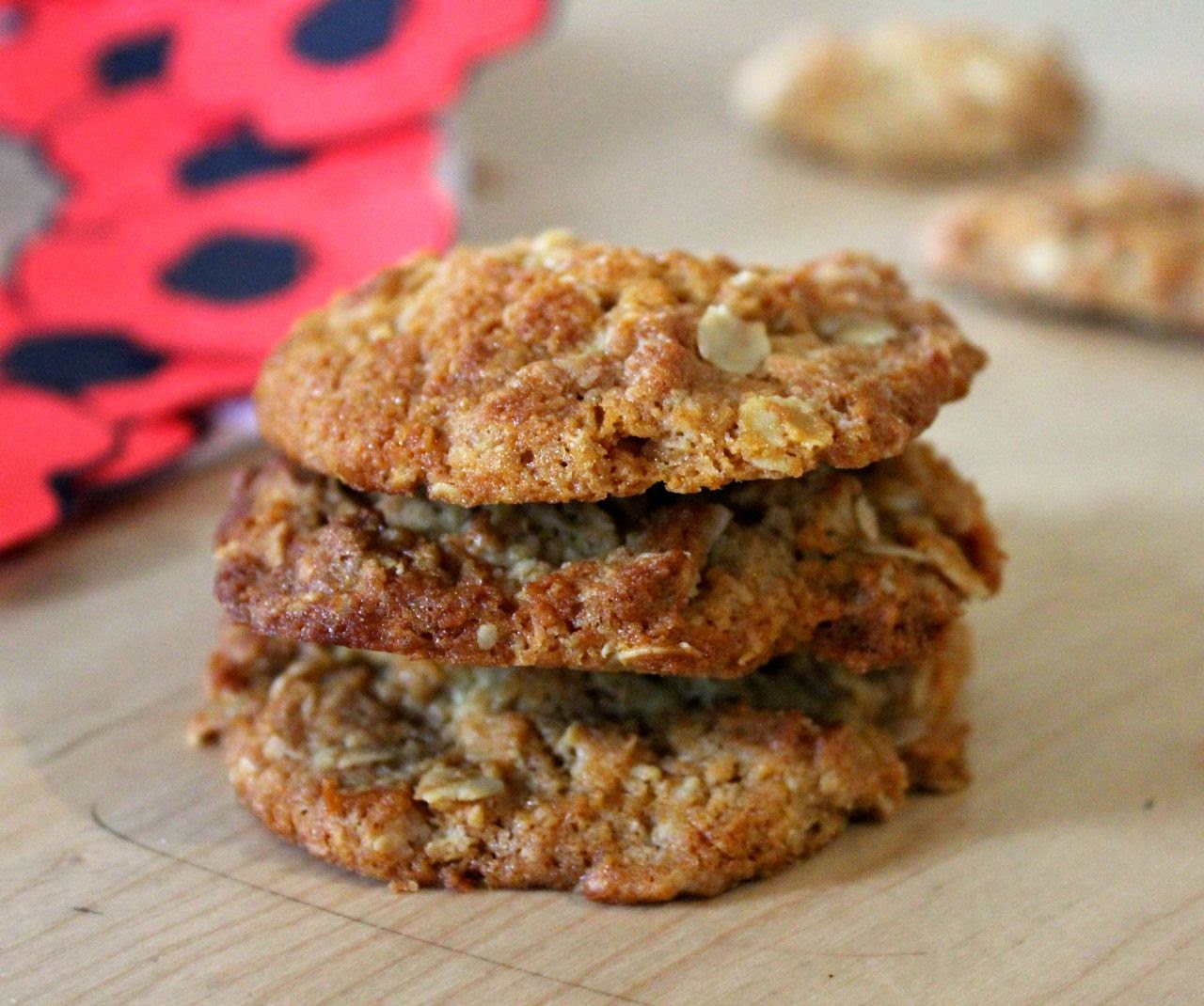
I am so glad I made these because it made me realize that this is my equivalent of what the choc chip cookies seems to be for Americans. As I have said before, the smell of melted butter and golden syrup fills me with nostalgia. These biscuits make me remember being young - wanting to eat all the raw biscuit mixture, being so amazed at the bicarb fizzing up in the golden syrup mixture, and wishing we had bought biscuits. It reminds me of having to keep all the utensils and saucepans with a daub of green paint on them at the green counter in the home economics room at school and proudly taking home freshly baked goods.

When I was young I don’t think I really appreciated my mum regularly baking us cakes and biscuits. How ironic because now I would much prefer homemade ANZACs to any that I could buy in a shop! My mum was right about this being a good recipe - they were flat, soft and buttery. I have checked a few other recipes and it seems this one has a bit less flour and oats than usual which is probably why they spread so readily. Oh, and apparently the recipe is derived from a Scottish recipe. So it is no surprise that E loved them too.

I am sending this post to Stephanie of Dispensing Happiness who is holding an Retro Recipe Challenge event called Your Mother Should Know. It asks us to make a recipe that was popular before our mother was born. I thought it was a hard ask until I realised that the biscuits I was planning came into that category.

ANZAC Biscuits
(from Cookery the Australian Way)
Makes 16 biscuits (or more)

¾ cup rolled oats
¾ cup plain flour
¾ cup dessicated coconut
Little less than ½ cup sugar
125g butter, chopped*
2 tbsp golden syrup*
1 tsp bicarbonate soda
2 tbsp boiling water
* I know that in America it is hard to get golden syrup - it is possible to substitute honey or corn syrup or treacle. Vegans can substitute margarine for butter. But I believe the characteristic taste of these biscuits really comes from the combination of butter and golden syrup so I encourage using them if possible.

Combine first four ingredients in a mixing bowl.

Melt the butter and golden syrup together in a small saucepan. When melted take off the heat. Mix the hot water and bicarb in a separate bowl and add to the golden syrup mixture. Mix and watch it froth up.

Once it is frothing, pour the golden syrup mixture into the bowl of dry ingredients and stir to combine. The mixture is quite sloppy which means it will spread a lot (If you like your biscuits a bit more firm and chunky you could add an extra ¼ cup flour and ¼ cup oats).

Drop teaspoonfuls onto a greased or lined baking tray. Leave plenty of room around them as they will spread quite a lot. I didn’t leave enough room for mine (maybe they were too big).

Bake in 160 C oven for about 10 minutes. My mum gave me the wise advice that your nose will tell you when it is cooked. Leave to cool on tray for 5-10 minutes and then use an eggflip or spatula to transfer to wire rack to cool.

On the Stereo:
Son of Evil Reindeer: The Reindeer Selection

Thursday, 24 April 2008

Carlton Farmers Market

Of late there seems to have been an explosion of farmers markets in Melbourne (figuratively speaking). One of the newer markets is the Carlton Farmers Market. It is held on the third Saturday of the month at the Carlton Gardens Primary School, close to the CBD (Central Business District) and just across the road from the Carlton Gardens where you will find the Melbourne Museum and the Exhibition Buildings. Prime real estate but not many farms in sight.

The school is a red brick Nineteenth Century building of arches, gables and chimneys. (I just boasted to E that my primary school was older than this one and he retorted the he could trace the history of his school back to the Twelfth Century – sometimes it is no fun having a Scottish partner!) The farmers market is on the inner city school playground. It is a smaller space than the Collingwood Children’s Farm Farmers Market and nowhere near the size of the sprawling Vic Market. But the Carlton Farmers Market had a friendly atmosphere and lots of fine food to tempt us.

We did the rounds of the stalls, chatting to stallholders and tasting the food. We spent a bit of time talking about spelt at the Knead Bakery. The stallholder told us it was less elastic than regular flour because it was low in gluten but that it smelt like vegemite when it come out of the oven. Another stallholder told us about how they were setting up a home business on the outskirts of Melbourne. We tasted cheese, pesto, prune and walnut log, spicy shiraz sauce and lots of different biscuits. Other stalls displayed olives, wine, honey, plants and gorgeous little cupcakes.

We took away a swag of goodies: orange and poppy seed biscuits, Chef’s Own basil pesto (which is such a lovely brilliant green), chat potatoes, corn , broccoli, brussels sprouts, free range eggs, Milawa cheddar, hemp soap (by Scent Sational Handmade Soaps) and spelt bread.

I will be back here because it is in such a great location and the goods are quality stuff. Afterwards you can walk in the park or a visit to the museum. (We did neither because E was keen to buy a guitar but I wont bore you with the saga.) The main improvement I would like to see is a vegetarian option at the sausage sizzle. But I think it is a great use of space that might otherwise lie empty on a weekend. Schools are a place for learning and a farmers market supports this by bringing us closer to the source of our food.

I am sending this post to Gay at A Scientist in the Kitchen for her event To Market To Market, which asks bloggers to share information about the local markets where they shop for food.

Carlton Farmers Market
Third Saturday of the Month
Carlton Gardens Primary School
215 Rathdowne Street, Carlton
http://www.carltongardens.vic.edu.au/farmers.shtml

Tuesday, 22 April 2008

Vegetarian Sausage Rolls

On the weekend I had a yen for sausage rolls. I mean the vegetarian variety, of course. Perhaps my neb at nut roast event has made me nostalgic for food from my childhood. Some might even argue that a vegetarian sausage roll is just a nut roast in pastry.

When I was too young to know any better and ate meat, sausage rolls were eaten at parties or just for light meals (or even sitting in a dressing gown in front of a soap opera, but I can’t mention names)! They were often offered as an alternative to meat pies which we called plasma pies (shudder of horror)! We usually had small sausage rolls that lots of little hands could grab and dunk in tomato sauce.

When I posted about making my version of vegetarian sausage rolls for party food last year, Cindy from Where’s the Beef kindly pointed me in the direction of the recipe she has been using for years. In her post Cindy remembers trips to the local bakery for sausage rolls. Such memories make me nostalgic for a time when I could stop at a bakery and eat any baked goods. I am of course nostalgic for the choice rather than the taste.

Many pie displays now include some sort of vegetarian pie but you still rarely find vegetarian sausage rolls when eating out. Cindy comments that this recipe should be shared with the world and, after finally making them, I can’t help but agree. It is easy and so delicious that I am sure there would be many takers if some enterprising person tried selling these. I thought the raw mixture was unbearably salty but when cooked it tasted so good. They are darker and richer than mine; closer in texture to that of their meaty cousins and packed with flavour.

The main problem is that these sausage rolls look so like the meaty ones that you could be mistaken for thinking they actually were. I mention this problem because it is easy to become paranoid about eating out when a vegetarian. Some meat eaters think it is hilarious to tell me the food they have just served up has meat in it, but it is too close to the truth to seem funny. Most vegetarians will have had the experience of being told that the stock is vegetarian, only to find bits of meat (or a ham bone) floating in the soup.

My mum has embraced the idea of choice and begun to make me some vegetarian sausage rolls when she makes meat sausage rolls but I worry she might mix them up. So I was inspired by the seeds on Cindy’s sausage rolls. I am now wondering if I should suggest my mum puts sesame seeds on my sausage rolls so it is easy to recognise the good ones! I know it seems obvious but it has just never occurred to me before.

Cindy’s sausage rolls with a mug of leftover mushroom stew were wonderful warming comfort food after a lazy Saturday. We even had a few for lunch the next day. This is an excellent version of a classic snack that I would recommend everyone try. Don't ask me who Liz O'Brien is because not even Cindy knows.

Finally, if you are looking for other ideas for filling vegetarian sausage rolls, you might like to try using the nut roast mixture from one of the recipes in the neb at nut roast round-up and baking it in pastry using the same method as in the recipe below.

Update Nov 2009: If you want a vegan version, see Cindy's vegan sausage rolls where she substitutes tofu for the egg and cottage cheese - I still mean to tr it some time.

Liz O’Brien’s Vegetarian Sausage Rolls
(from Where’s the Beef)
Makes about 28 x 5cm (2 inch) sausage rolls

Filling:
3 eggs, lightly beaten
1 cup (125g) pecans, chopped finely
1 medium to large onion, finely chopped
1 vegetable stock cube (I used 1 tsp of stock powder)
1 clove of garlic, crushed
3 tablespoons soy sauce (I used 2 tbsp tamari)
250g cottage cheese
1 cup rolled oats
½ cup breadcrumbs

3 to 4 sheets of ready-rolled 25 x 25cm puff pastry
Beaten egg for glaze
Sesame seeds for sprinkling (optional)

Combine all filling ingredients in a mixing bowl.

Thaw 3 to 4 sheets of ready-rolled puff pastry. Place the first sheet on a flat surface and cut it in half, into two rectangles. Spoon the non-sausage mix down the centre third of each rectangle. Brush one long edge with beaten egg and fold in the long edges so the one with beaten egg overlaps the other edge.

Repeat with other pieces of puff pastry. Brush with beaten egg (or milk) and sprinkle with sesame seeds. Place sausage rolls seam down on a greased or baking-paper lined baking tray. Use a sharp knife to slash marks across the pastry. You can use the knife marks to indicate where to cut them after cooking (halves, thirds or quarters) and/or to make decorative marks

Fill all the pastry and bake sausage rolls at 220C for 20 minutes. I cut up the sausage rolls after they are cooked so the ends don’t dry out too much. The ones that you want to eat now should be kept in the oven for an additional 10 minutes or til golden brown.

Take out any rolls that you don’t want to eat and cool. These can be frozen for later. The leftovers can go straight from the freezer into a 220 C oven to cook for 15 minutes.

Serve with tomato sauce.

On the stereo:
Cross: Tom Hall

Sunday, 20 April 2008

A Neb at Nut Roast – the Round Up


Back in March I challenged my readers to have a neb at nutroast (see this post for more nut roast info). The response was a mixture of interest, curiosity and confusion. It seems there are many bloggers who have not encountered the lovely nut roast.

I am pleased to report that 14 nut roasts were sent to me for this event. In addition I made 3 over the period so we have a total of 17 nut roasts of many shapes and flavours (or 16 nut roasts and one imposter!). It is what I had hoped for. I gave quite you a reason to partake of the joys of the nut roast and in return I received a wealth of creativity and innovation. It delighted me to read some of the dialogue around nut roasts in the blogosphere. Finally I don’t feel like the only person in the world in love with nut roast.

Not everyone professed undying love for the nut roast. Quite a few commented quite reasonably that it would not be an everyday dish. But when you see the variety, I hope it will inspire you to cook it occasionally, especially when you want a special vegetarian meal.

I was delighted to see example of roasts that I have only dreamt of trying. Nut roasts were presented in puff pastry, in muffin sizes, stuffed, and panfried in slices. Ingredients I have never encountered in a nut roast were also on display, such as quinoa, spinach, pistachio, flaxseeds, gruyere cheese and shitake mushrooms, plus useful nutritional information and wonderful colour. Something for everyone! Here are the entries in the order in which I received them.

1 Mushroom Nut Roast - Culinary Bazaar, California USA
Dhivya was no newcomer to nut roast. She shared a lot of useful nutritional information about heavenly brazil nuts which she used in her recipe. Her nut roast looks delicious with a drizzle of tomato sauce. Her description of it as sinfully rich and addictive sounds spot on! And she wisely warns that you can certainly have too much of a good thing which is why she does not make nut roasts too often!


2 Cheese and Nut Roast - Nourish Me in Melbourne Australia
Lucy made a variation on Deborah Madison’s nut roast recipe. Her use of wild rice, shitake and porcini sounds a bit more exotic than the usual British stodge! But Lucy was doubtful about the merits of a dish with so much cheese and nuts. She ate it with a daub of tomato and basil sauce and was then ready for a truckload of salads and veggies. However, it is not her first nut roast so Lucy is open to others.

3. Cheesy Nut Loaf - Green Gourmet Giraffe, Melbourne Australia
This nut roast is an old recipe that I have tried a few times. In addition to nuts it is full of rice, cheese and vegetables. On this occasion I enjoyed it as an alternative to my mum’s roast lamb when my family got together for Easter Sunday lunch. It was served with my mum’s dazzling array of vegetables – roast potatoes, roast pumpkin, cauliflower cheese and peas.

4 Nutloaf with Shitake Mushrooms - Confessions of a Food Nazi from Melbourne Australia
Another Outspoken Female reminisced about her happy Christmas dinners of nutloaves in London many years ago. She kindly drew deep into her memories to come up with a pleasing nut roast recipe made with tofu and shitake mushrooms, served with roast vegies. I love her relaxed way of measuring the ingredients which will appeal to others who take quantities with a pinch of salt. Check out her wonderful retro tableware for that old-school 1970s nut roast experience.

5. Pistachio Cashew and Spinach Nut Roast, Little Bits, Pacific North West
LisaRene moved on from nut balls to discover their big brother the nut roast. A newcomer to nut roast, she was adventurous with her recipe and had no regrets. She also used tofu and lots of spices. The photos of the slices show a fantastic brilliant green loaf which was so good LisaRene ate it plain without any sauce. It sounds as though her guests might have some delicious nut roasts served up to them in the future.

6 Fantastically Mushroomy Walnut Roast - Munchkin Mail, Warwickshire, UK
Lysy was unexpectedly smitten by nut roast. She overcame her bad experiences in being served nut roast and her dislike of nuts to make a magnificent and nutritious nut roast. Lysy discussed the nutritional merits of walnuts and also added lots of yummy seeds. She served it with sweet potato chips, pear and leaf salad and a bit of broccoli. I particularly love her instructions at the end of her recipe – ‘serve and enthuse’!

7 Quinoa Nut Roast - Addicted to Cooking, Auburn, Alabama, USA
I was excited to get Marie-Lies’ submission as it was the first with quinoa I had seen. She used flaxseeds to make it vegan as well as gluten free. She served it with what I think are vegetarian Native Foods ‘chicken’ nuggets and sweet and sour sauce. Her mum and boyfriend ate it with her and all found the result pleasing. Marie-Lies says she will make it again but will be experimenting with different combinations.

8 Parsnip Nut Roast - Green Gourmet Giraffe, Melbourne Australia
This nut roast I made was full of mashed parsnips which gave it a distinctive taste. I substituted soy flour for the egg and was pleased to find it was quite easy to veganise the recipe. Deciding it was impossible to be simple with nut roasts I served it with a British-inspired accompaniments of mashed potato, gravy, sprouts and little Yorkshire puddings.

9 Stuffed White Nut Roast - Where’s the Beef? Melbourne Australia
Cindy dusted off an old recipe that had caused her grief in the past. Nut roasts have a way of sticking to the loaf tin or the paper, so she has found it necessary to line the tin with well-greased baking paper. Wise advice indeed! She was ably assisted by her partner in crime (so to speak) Michael, who helped with all the chopping and sautéing required. The result was a beautiful golden crusted loaf (which wasn’t afraid to part company with the paper) with a parsley and lemon stuffing. Sounds worth the perseverance! And as you will see from the photo, Cindy also enjoyed leftovers sliced in a sandwich.

10 Mushroom Nut Roast in Puff Pastry - Lisa’s Kitchen, London Canada
Despite being a beans and grain kind of girl, Lisa did some research and come up with a delightful looking nut roast wrapped in puff pastry. She mixed her nuts with mushrooms, quinoa, sundried tomatoes and, of course, loads of spices, and served it with a salad and salsa. Although she does not usually serve nuts as a main dinner feature, Lisa was pleasantly surprised with the results. It looks superb.

11 Michaelmas Loaf - Green Gourmet Giraffe, Melbourne Australia
The final nut roast from Yours Truly. I delved into the history books to find out about the history of the nut roast and found it was indeed alive and kicking (to coin a phrase) at the turn of the century. To complete the research, I made a nut roast from a 1910 cookbook which was moulded and basted to look a bit more like roast meat than my usual ones. It was a bit nuttier and drier than the nut roasts I am accustomed to but with some gravy, roast potatoes, roast pumpkin and roast peas, it did make me feel like I was eating one of my mum’s roast dinner!

12 Nut Roast Extraordinaire - Diet, Dessert and Dogs, Toronto, Canada
After being won over by the nut roast earlier this year, Ricki was eager to participate in this event. She is eloquent in proclaiming undying affection for the ‘meal in a brick’. Even her carnivorous HH enjoyed it immensely. Her nut roast was chock full of vegies, herbs, wine, oats, cilantro (fresh coriander) and flaxseeds, as well as brazil nuts and cashews. Served with a kale salad, it had lots of nutritional benefits and looks wonderful.

13 Walnut and Mushroom Roast - Eat Me, Delicious, Vancouver Canada
Ashley was intrigued by this ‘mysterious loaf’. She thought she was embarking on a new experience until her mum reminded her that she had made one years ago. That gave me a laugh. Nevertheless Ashley was delighted with the results of this herby tomatoey nut roast and was happy to eat it just with some steamed broccoli. It is a recipe I have blogged before but I didn’t manage to create such a lovely rosy hue. She is now planning to make nut roast for future Thanksgiving meals and anytime meals.

14 Mini Herbed Tomato Nut Roasts – Jugalbandi, North Western USA
Bee and Jai also made nut roast full of tomatoes and herbs but they also added gruyere cheese, roasted red peppers and nutritional yeast. The herbs came from their garden and included the intriguing sounding pineapple sage. Their nut roast was cooked in muffin moulds and looked stunning served on slices of tomato. I liked the advice in the recipe that the batter will not rise like a cake. Something that I take for granted but would be helpful information for novices. It is also worth reading Bee’s story of her university serving such bad nut roast that she preferred the kangaroo stew. Glad that she liked this one more!

15 Nut Roast - Lost in the Kitchen, Belgium
Joanna overcame her suspicious of nut roast, despite the mixture smelling like something meat eaters such as herself would not want for dinner. Once it came out of the oven she loved it so much that she was looking forward to going home for the leftovers the next night. Hers was full of vegetables, cheese, oats and Worcestershire sauce. It didn’t brown as much as she wanted, so she panfried it in herb butter and served it with apple sauce. Sounds wonderful.

16 Cumin, Carrot and Cashew Nut Roast - A Wee Bit of Cooking, Scotland
Wendy made wee individual nut roasts in ramekins (now why haven’t I thought of that!). They look cute and shapely, served them on a bed of simple green leaves. This was the first nut roast Wendy has made, despite a love of nuts. She found it absolutely delicious and is now looking forward to ‘more nutty roasty experiment’.

17 Orange and Brazil Nut Loaf - Tinned Tomatoes, Scotland
Here is the imposter! Holler was full of good intentions and went out to buy the ingredients for her nut roast, having made her first one some months ago. But somewhere something went wrong. She refused to be held hostage by a blog event and followed her whims. Instead of a savoury nut roast, Holler sent me a sweet orange and nut cake! Tut tut tut! I have included it because I know she has her heart in the right place and because it illustrates just what a nut roast isn’t. It isn’t sweet, it isn’t airy and it isn’t a cake. Full marks to Holler though for finding a cake that has a resemblance to a nut roast! And it does look scrumptious.

Thank you to everyone who participated. (Please let me know if I missed anyone.) I feel inspired anew by all the fabulous versions of the nut roast. I am sure I am not alone in wanting to try out these nut roasts very soon.

HoTM French Toast with Fruit

I’ve never eaten French toast because I couldn’t bear the thought of bread soaked in eggs. I once had a housemate who made it regularly and generously offered to make it for me but I shuddered when I watched him cracking open egg after egg. Viewing it on menus and neighbouring plates in cafes has filled me with desire but not enough to overcome my egg-aversion. But there have been days I have thought I would love to eat it if only it wasn’t so full of eggs.

So I was excited to find there are vegan versions of French Toast. This weekend I decided I would make some for brunch. When I told E of my plans he surprised me by being unusually knowledgeable.

Now I expect him to know anything and everything about music and movies. Last week when a work colleague asked what movie was being filmed in Melbourne with Nicholas Cage in it, I didn’t have a clue but was confident that E would know. Within an hour of emailing him the question, I got the answer. Apparently the movie is called Knowing. But most culinary matters are beyond E’s ken.

So I was impressed that he told me his granny used to make him French Toast and that he had learnt from her that it was a recipe used in wartime. He thinks that this was because it made eggs go further in days of rationing. So I had to go online and investigate.

The Food Timeline says that French Toast can be traced back to the Roman Empire. It is known by many names in many countries. The most poetic is the French name ‘pain perdu’ which literally means lost bread and alludes to the dish being a way of reinvigorating stale bread. It is popularly thought to be a humble recipe employed to use up every scrap of food, but in fact was also made with the finest of foods and spices as a rich man’s fancy. Nothing about the war. Nor did Wikipedia enlighten me. In fact the only reference I could find to French Toast in the war was a claim that the name was changed from German Toast to French Toast in America. I will keep searching and would welcome any information.

So, it seems that French Toast has a fine heritage, but I cannot substantiate E’s claim. However, I can tell you that he does know more about eggs than me because he loves them. In fact, the first time we ate out together he had a fried egg roll at an internet cafe! I suspect it was covered in tomato sauce.

Yes, E likes eggs and tomato sauce. So when I made the French Toast he was surprised when I served it with fruit. He had expected it with tomato sauce. I asked how his granny served it and he said she just made it as a snack for him when he was a wee boy.

I had decided I would make the French Toast for the Heart of the Matter event which this month is hosted by Joanna and the challenge is a healthy brunch. Joanna is feeling a bit jaded and has asked for inspiring ideas for a healthy brunch. I thought I would serve the French Toast with an interesting combination of baked fruit.

I had some rhubarb left from the bunch that I bought last weekend. I also fancied trying my hand at roasting strawberries after being impressed by SweetDesigns' success recently. And lastly, I wanted to make a version of my mum’s bananas with lemon juice and sugar that she made us when we were kids. I didn’t put a lot of sugar in but served the fruit with a generous amount of maple syrup. I was also pleased to be able to use my pomegranate juice and my candied orange but orange juice and orange zest would work as well.

The French Toast didn’t crisp up the way I had hoped. It was only by the time I got to the third piece of toast that I finally achieved the golden brown fried look. I know that frying it in a pool of oil is one alternative but I intend to try some other dipping batters to see if others are more compliant. This one was interesting but it didn’t really enthuse me. Did I tell you I don’t really like soggy bread much either? And maybe the fantastic heavy wholemeal sourdough from Hope Farm was not the right bread for the recipe. I will try French Toast again but next time I think I will take E’s advice and eat it as part of a savoury brunch.

On the other hand, the baked fruit was heavenly but I think I would prefer it with pancakes. I followed a recipe which suggested rhubarb would take 45 minutes to bake and I thought I had lots of time for the laundry, watering the plants and blogging before breakfast but it turned out that 20 minutes was ample. E thought the rhubarb a bit tart but it was nothing that couldn’t be fixed with a bit more maple syrup. I have written a recipe for the fruit which is a composite of what I did and what I would do next time. Other fruits could be used but unfortunately I am less inclined to turn on my oven summer when stone fruits are plentiful. However, I am looking forward to experimenting more with baking fruit for brunch.

French Toast with Baked Rhubarb, Strawberries and Bananas
Serves 4-6

French Toast

(from Vegan Family Favourites by Erina Pavlina)

¼ cup almond butter
2/3 cup milk
1 tsp cinnamon (optional, I just gave it a good shake)
6 slices of thick bread
Oil for frying
Baked fruit (recipe below)
Maple syrup to serve

Place almond butter, milk and cinnamon in a food processor and blend til smooth. (I did a bodgy job because I was trying to avoid the noisy food processor so early in the morning but in retrospect I would advise it.)

Pour milk mixture into a shallow dish (like a pasta bowl). Heat a heavy frypan. Pour a drop or two of oil into it and wipe with a paper towel so the surface shines with grease. Place a piece of bread in the milk mixture and flip over so both sides are soaked in the milk. Place soaked bread on the frypan. Fry a few minutes either side over medium heat or til bread is golden brown on both sides. Serve with baked fruit and maple syrup.

Baked Rhubarb, Strawberries and Banana

1 cup rhubarb, chopped into 1 inch lengths
125g strawberries (½ a punnet), hulled
4 tsp of sugar (or try maple syrup or agave nectar)
20g candied orange, chopped finely, or orange zest
¼ cup pomegranate juice, or orange juice

1 medium banana, chopped roughly
Juice of half a small lemon
1 tsp sugar

I couldn’t find a baking dish the right size and used separate ramekins for the rhubarb, strawberries and banana. I think in retrospect I would put rhubarb and strawberries together. So you can either divide up the sugar, orange and pomegranate juice and bake the rhubarb and strawberries in two ramekin dishes or bake together in a small baking dish. Toss fruit with juice, sugar and orange to coat. Cover with foil and bake in a 200 C oven for about 20 minutes or until soft but still keeping their shape. (Check and stir after about 10 minutes.)

Once the rhubarb and strawberries are in the oven, toss banana, lemon juice and sugar in a ramekin. Cover with foil and place in oven for 20 minutes. (Check and stir after about 10 minutes.)

Serve hot baked fruit over French Toast (recipe above), pancakes or waffles. If not sweet enough douse in maple syrup.

On the Stereo:
John Denver’s Greatest Hits

Saturday, 19 April 2008

NCR Moody Mushroom Stew

I was wondering what to write about my mushroom stew when we sat down to watch the DVD of Control last night. This wonderful film tells the story of the late Ian Curtis, the Mancunian lead singer of post punk band Joy Division. It is a beautiful film shot in black and white by Anton Corbijn who had taken iconic photographs of Curtis before his suicide in 1980.

I first bought a Joy Division album in my early 20s. I was quite taken with the breathtakingly beautiful Love Will Tear Us Apart single. The album disappointed me because the other songs were so different. It has taken me years to learn to appreciate the depth of the passion and the sadness that imbues these songs.

If I dare to be so bold as to make a comparison between the sublime and the stew, this made me think about my journey with mushrooms. To be honest, I was only making mushroom stew for Holler and Lisa’s No Croutons Required event which this month challenges us to make a mushroom soup or salad. I never liked mushroom as a child and never was swayed by the claim that they are meat for vegetarians. I don’t like meat and sometimes feel that the comparison is a little too close for comfort. But I have come to appreciate them more over the years. In fact, I love mushrooms in my meals, but still have reservations about eating them solo.

There is another reason for not being able to work up a lot of enthusiasm for mushrooms, or ‘mushies’ as we often refer to them here. They don’t add much colour to a meal. In fact, too many of them can reduce the most colourful meal to a grey sludge. Grey certainly is not on the list of my favourite colours. Grey is a gloomy rainy day, grim industrial chimneys, soul-destroying high rise flats. Sure, in a salad they can retain an interesting white and black but even then they have to be mollycoddled to prevent them getting slimy. Now, I am sure many of you are protesting that they taste so good, but my reply is that food needs to look appealing to make it near your mouth, and I am sure I don’t need to remind you where mushrooms are grown.

Despite all my prejudices, I decided I was going to challenge myself to find a mushroom soup for this event. A few piqued my interest. I settled on a Mushroom Madeira Stew from the Café Flora Cookbook. The stew attracted me for two reasons: 1) it had carrots, potatoes and peas to give some relief from the grey and from the mushroom taste, and 2) I really enjoyed pairing mushrooms and sherry in quesadillas recently.

The combination of flavours in the soup is superb and I would make it again. It was a little thin for my liking and so I used the handheld blender to puree a little of it which helped thicken it. My main problem with it was the … ahem … mushrooms. I sliced them thickly and didn’t really fry them much and they were a little chunky. In future, I will slice the mushrooms more thinly and make sure they are thoroughly fried before adding the roux.

Then after we’d finished the soup, we sat down to watch Control and as I watched it I couldn’t help comparing the black and white hues to the mushrooms. I am no Anton Corbijn, but I decided it would be fun to make my photos black and white just to make a point about their colourlessness. And you know, it has convinced me that mushrooms do have a kind of bleak beauty.

Mushroom Sherry Stew
(from the Café Flora Cookbook)
Serves 4

- 3 tbsp oil
- 2 tbsp plain flour
- 1 medium yellow onion, chopped
- ½ tbsp salt
- 4 cloves garlic, crushed
- 3 tbsp fresh parsley, chopped
- 1 tbsp fresh thyme or 1 tsp dried
- 2 tbsp nutritional yeast flakes
- 1 tbsp tomato paste
- 400g (2½ cups) Portobello mushrooms (or cremini or shitake or a combination), thickly sliced
- 6 cups vegetable stock, warmed
- 2 large potatoes, diced (approx 2 cups)
- 2 large carrots, diced (approx 1½ cups)
- 1 ½ cups frozen peas
- 1 bay leaf
- ½ cup dry to medium dry sherry (or Madeira or red wine)
- ½ tsp freshly ground black pepper

Heat 2 tbsp of oil in a small frypan and add the flour. Stir over medium high heat for a few minutes until it smells toasted and looks golden brown. Set aside (know as the roux).

Heat 1 tbsp oil in a large stockpot and fry onions with salt for about 10 minutes til soft and translucent. Add garlic and cook another minute. Add mushrooms and cook til soft and beginning to release their juices. Add the thyme, parsley, nutritional yeast, and tomato paste and cook 2 minutes, stirring occasionally.

Stir in the roux and gradually add the stock, stirring frequently, to make sure the roux is blended. Add the potatoes, carrots, peas and bay leaf. Bring to the boil, cover and simmer about 20 minutes. Add the sherry and simmer for no more than an additional 5 minutes. Remove bay leaf, add pepper and check the seasoning. Serve hot with bread or salad.

On the Stereo:
Still: Joy Division

Friday, 18 April 2008

Happiness Chowder

‘Is the inside yellow because I want to make a yellow soup?’ I tried to explain to the stallholder. ‘Oh no,’ she chided me, ‘it should be just roasted or steamed.’ Thus was the incomprehension of the proud producer of gorgeous yellow heirloom pumpkins at a farmers market last weekend. Let us rewind so I can explain.

Last year around this time I was dreaming of having a blog. This was a time before I had experienced the kindness of other bloggers, before I understood what a blog event was, before I could join in. I read about the Taste of Yellow 2007 event and wanted to be part of the action. The round-up of 149 bloggers was truly inspirational. This year I find myself a veteran of many blog events and eager to join my fellow bloggers in a Taste of Yellow 2008.

A Taste of Yellow is held by Barbara of Winos and Foodies in honour of LiveSTRONG Day to promote cancer awareness. Barbara had experienced the shock and fear of cancer herself. I don’t think there are many of us who are untouched by cancer. I have seen it affect family, friends and work colleagues in various ways. Rather than write about the people whom it has touched, I wanted to think about yellow and why Barbara chose it. I thought I would focus on two yellow characters: Judas and the Smiley Face.

Yellow is the colour of Judas Iscariot, one of the 12 disciples who is best known for betraying Jesus with a kiss in return for thirty pieces of silver and thus giving up Jesus to be crucifixion and death. In medieval paintings he was represented in a yellow gown and in one webpage I found a claim that yellow is never used in churches because it is associated with Judas. It is betrayal rather than Judas’ cowardice that I think is symbolic of cancer. Cancer is the betrayal of our own bodies. Cancer betrays our belief that science and medicine can protect us. Cancer betrays our hopes for a good long life by striking us with a senseless illness and grief.

Yellow also is the colour of the ubiquitous Smiley Face. This is the cheery little yellow circle with two dots for eyes and a half circle for a mouth. The smiley face has had a few different meanings over the years. Where once it meant Acid House Music and drugs, today it is most often seen filling our computers with smiles. The Smiley Face is reminiscent of the innocent joy of a child’s picture. Yes happiness is the flipside of the betrayal of cancer. Cancer makes every little bit of happiness important. It might be the happiness of knowing others are supporting and helping us, of enjoying living while we can, or knowing how lucky we are to survive cancer. Sadly, sometimes the only happiness is in the memories of those left behind. But some happiness must eventually be embraced to go on.

So when I saw that A Touch of Yellow was on again this year, all I could think of making was Nigella’s Happiness Soup. I saw the recipe years ago on the telly and found it recently when I borrowed Forever Summer from the library. It is a simple soup of yellow zucchinis, lemon, basmati rice and turmeric. Nigella talks of the ‘sunny, mood-enhancing yellowness’ and quotes Claudia Roden who says that in the Middle East it is believed that eating yellow foods results in laughter and happiness.

By the time I started looking, the brief moment of yellow zucchinis had passed. Then the yellow heirloom pumpkins filled me with a hope that I could adapt Mandira’s recipe for Winter Soup with Butternut Squash, Acorn, Corn and Wild Rice, which I had been keen to try since seeing it on the No Croutons Required round up. This is why I was more interested in taste than colour as I talked to the market stallholder.

If you see Mandira’s recipe you will see quite a different looking soup to mine as she pureed the vegetables but I left mine in roasted chunks because I wanted to show some respect to these wonderful pumpkins. It was so thick that it was more like a stew than a soup so I called it a chowder. The vegetables were quite sweet with hints of lemon and spice. It went well with the dosa which were quite savoury. Most importantly, I was very pleased with the yellow colour and so was my giraffe. I hope it will bring a little happiness to Barbara.

Pumpkin, Corn and Wild Rice Chowder
(Adapted from Nigella and Mandira)
serves 4

400g pumpkin, peeled and diced
3 pattypan squash, diced
2 corn cobs
2 tbsp olive oil
1 cup wild rice, uncooked*
1 medium onion – chopped
3 cloves garlic, crushed
1 tsp tumeric
½ tsp cumin powder
½ tsp chilli paste
zest and juice of 1 small lemon
2 cups vegetable stock
salt and black pepper to taste
cream to serve (optional)
*I cooked half wild and half brown rice, but it made a lot for the chowder. Maybe Mandira meant one cup cooked rice. Next time I will cook less.

Place pumpkin, squash and corn on the cob in a roasting tray and drizzle with 1 tbsp olive oil, salt and pepper. Roast in a moderate (180 C) oven for 1 ½ hour.

While the vegetables roast, cook the wild rice in boiling water for about 45 minutes or til cooked (I put the brown rice in after the wild rice had been cooking for 15 minutes).

When vegetables are cooked, you can choose to puree the pumpkin, squash and corn or you can keep them in chunks.

Heat the remaining tbsp of oil in a large saucepan and fry the onions for a few minutes til softening. Add the garlic and spices and stir for 1 minute. Add vegetables, rice and stock. Bring to boil and cook 4-5 minutes. Check seasoning.

On the Stereo:
His and Hers: Pulp

Thursday, 17 April 2008

Family Favourite: Chocolate Pudding

When I lived in Edinburgh, I would frequently visit my brother Andy and sister Chris in Dublin. This was all the family I had over that side of the world. Without fail, Andy would cook us chocolate pudding just like my mum used to. He made it so often that he didn’t even need a recipe. For a while he experimented with different versions but always came back to the original. It felt like home.

My mum made us sweets (or dessert) almost every night when I was growing up. One of the most frequent and favoured sweets was chocolate pudding. In fact, we loved it so much that my dad once attempted to make it when she was in hospital for the birth of one of my siblings and we never forgot his sloppy chocolate pudding.

A few months back, I decided to make it for E and I but I couldn’t find the recipe. Andy had emailed it to me ages ago but I had lost it so I just used the Australian Women’s Weekly recipe, naively assuming that ours must be a common Australian recipe. I know from my blogging that ‘chocolate pudding’ in America is not my chocolate pudding. Mine is a hot, lightly crusted chocolate sponge swimming in a pool of dark chocolatey sauce. Others might know it as self-saucing chocolate pudding.

The pudding I made was disappointingly bland and I returned to my mum for the recipe, assuming she had the original. She couldn’t find it and thought that Andy might have it and then in a burst of clarity remembered the recipe and gave it to me over the phone. The instructions that I scribbled down might show just how natural it seems to me to make it: ‘Mix all pudding ingredients and place in bowl – bake 150 C for 1 hour-ish’. It also shows how simple it is.

My mum also told me that this was her mum’s recipe. That makes sense to me as one of my early memories is being at Nanny’s place in South Caulfield that she left when I was about 12. I remember her stirring the pudding in a bowl with a wooden spoon. I think at the time it struck me as odd to mix a chocolate pudding batter by hand because I knew that my mother always made chocolate cake with the electric beaters.

The trick to my nanny’s recipe is that it has more cocoa and is cooked slowly in a cooler oven than the AWW. My mum often used dessert spoons to measure cocoa when I cooked with her as a child and following her recipe I have used dessert spoons. Ironically they are larger than the tablespoons I now use (but not larger than mum's old tablespoon that I may photograph for my blog some time). For clarity I have photographed a spoon of cocoa next to a tablespoon.

As any chocoholic will appreciate, the more cocoa, the better. So in this recipe heaped spoonfuls are best. In fact, I think my pudding last weekend was particularly good because I lost count of the spoonfuls of cocoa and probably put in a little more than the recipe called for.

I made it to serve with nut roast on the weekend to complete a meal like my mother use to make. The pudding you see here is my Nanny’s recipe and it truly is manna from the gods. Dark, rich, soft, seductive. It comes out of the oven filling the kitchen with a heavenly chocolatey aroma. It seems something of a miracle that you put it in the oven with flavoured water sitting on the pudding batter and it comes out with a sponge pudding sitting over a wonderful thickened sauce. It is the finest of comfort foods and brings back memories.

Imagine 7 small excited children sitting around a large wooden kitchen table watching my mother’s large serving spoon hovering over the pudding. That is a image of my childhood. The moment that the spoon cracks the crust and digs into the sauce is always a happy one. The first serving might look good with the smooth topped wedge of pudding surrounded by sauce but inevitably by the end, the servings are unattractive messy clumps covered in sauce. But no matter how it looks, it tastes so good.

My mum always served it with thickened cream (which strangely is a thin pouring cream) but I always refused because I never liked cream. E had cream. He thought he should have custard with it which shows how little he understands the charms of chocolate pudding.

Chocolate pudding is a still frequently made in my mum's house, especially when any of the family are over for dinner. She wouldn’t dare stop making it because it is always in demand.

I am sending this to Bella Baita View for this month’s Apple and Thyme, an event founded by Jeni Of Passionate Palate and Inge of Vanielje Kitchen that is dedicated to remembering cooking with and by members of our families.

Chocolate pudding
Serves 4-6

60g butter (or margarine), softened
½ cup sugar
3 dessertspoons cocoa
Little less than a cup of self raising flour
½ cup milk

Sauce:
3 dessertspoons cocoa
¾ cup brown sugar
1¼ cup boiling water

Stir all the pudding ingredients together till combined and spoon into a greased ovenproof baking dish. (I like to use a round 20cm diameter dish that I got for my 21st birthday from my siblings.) Mix the sauce ingredients in a jug and stir well. Pour over pudding (but don't stir pudding mix and sauce together once in baking dish). It looks odd and watery if you have never done it before but it works. Bake in a 150 C oven for about 1 hour til top is crusted and the pudding smells good. Serve with cream if desired.

On the Stereo:
The Good Son: Nick Cave and the Bad Seeds

Tuesday, 15 April 2008

My Daring Darling Dosa

I’d never heard of dosa until last year when my friend Yaz raved to me about the masala dosa at Nila. It truly was a joy to behold. A wafer-thin pancake, crisp on one side, soft underbelly and stuffed with mushy spicy potatoes. Ever since I have hankered after dosa. How I have admired bloggers who dare to make dosa. Then I saw that Srivalli is holding an event to celebrate dosa.

Wikipedia describes dosa as a ‘South Indian crepe’. It seems that dosa is usually made of rice and split skinned urad dal (a type of black bean or lentil) which are soaked overnight to ferment, finely ground and then fried like a pancake. Apparently it is considered a breakfast dish but can be eaten at other times of day. Making dosa is quite foreign to me and I found Lisa’s advice very useful.

I have written before that I am challenged by Indian cooking. Lately I have made a kofta dish so spicy that E didn’t even reach for Tabasco, a dahl sadly lacking in spice, and a chappati that involved the smoke alarm (more of that another time). So I was a little wary of trying my hand at dosa. I am not good at light and fluffy food which seems likely to float to the heavens if not weighted by a good masala. Instead I turned to a red lentil dosa recipe in one of my cookbooks because the picture suggested it was made of sturdier stuff.

The biggest challenge with the dosa was timing. I needed to plan 32 hours ahead! This makes bread baking seem quick. But plan I did. Last night I got home from one of the most bleak, unrelenting, unrelaxing films I have seen for ages (Before the Devil Knows You’re Dead) and stood with the noise of food processor motor pounding in my head as I willed the rice and lentil mixture to become smooth. Nay chance! It took forever and then I gave up and decided I would have to live with a little gritty texture. Today I rushed home from work and checked the mixture again, hoping it might have softened overnight but it still felt more mud pie than the anticipated smooth batter.

I almost threw out the batter and swore off attempting any more Indian food. But I don’t like wasting food any more than I like giving up so I persevered. I was pleasantly surprised with the results. The itty bitty rice particles seemed to dissolve on the frypan. The dosa was wonderfully spicy and chewy. I served it with a mildly spiced chowder. It was unusual, nice, different!

I will be trying out more dosa after this one. Thanks Srivalli for the prompt I needed.

Red Lentil Dosa
(from The Complete Book of Bread and Bread Machines)
Makes 6

150g / ¾ cup long grain rice
50g / ¼ cup red lentils
250ml / 1 cup warm water
1 tsp salt
½ tsp turmeric
½ tsp freshly ground black pepper
2 tbsp fresh coriander, chopped (I used parsley)
Oil for frying

Place rice, red lentils and water in a small bowl and soak for 8 hours. Drain water and reserve. Place lentils and rice in food processor and blend til smooth. Then add reserved water gradually. (Mine was more gritty than smooth and I found I needed a little water to get it to this stage.) Cover and stand for 24 hours.

Stir in the turmeric, pepper and coriander (or parsley). The recipe also suggests adding ginger, chilli or shredded coconut as optional extras. Heat a heavy frypan over medium high heat and smear with oil (I tip a few drops of oil on the frypan and wipe it around with a paper towel). Place a quarter cup (40-60ml) of batter onto the frypan and use the back of a spoon to spread it into a circle of about 15cm diameter.

Cook for about 2 minutes or until set. (Here I found my pancake experience useful as it was quite similar in that the batter thickened and air bubbles began to appear when it was ready). Turn over and cook another minute or so. I found it took on a lacy golden brown pattern on the side where it first cooked but did not go golden brown on the other side. Repeat with remaining batter. Serve warm.

On the Stereo:
Clear: Conveniens

Monday, 14 April 2008

Relishing Rhubarb

I love a farmers’ market. I want to buy all the wonderful fruit and vegetables spread before me but I often get the cooks equivalent of writer’s block. My mind is blank as I search for ideas about how to make good use of such bounty.

This was my experience yesterday at the Farmers Market at the Collingwood Children’s Farm. I really wanted to buy the gorgeous rhubarb but was at a loss for how I would use it. There are only so many desserts and cakes I can make. Then I remembered Pixie and Rosie’s event, Putting Up. It was the excuse I needed. You will see from my picture that I managed to get home with quite a swag of goodies from the market (and the shops on the way home).

I had seen a rhubarb relish by Kai when browsing the In the Bag event on Rhubarb a few months back. Aren’t blog events wonderful things? They help justify buying food from markets by providing inspiration for uses and even suggesting recipes.

Pixie and Rosie’s event is a good prod for me as I would like to make jams and chutneys and other preserves more but I worry about sterilizing jars and not having a huge pot like my mum’s to make preserves in. But Kai’s picture of the brilliant ruby spread convinced me I must make this rhubarb relish.

Wikipedia says relish is a condiment made of fruit or vegetable pieces in a sauce which is a little chunky and complements another food. So why is it a relish and not a chutney? According to Crosse and Blackwell, the difference between chutneys and relishes is that you put fruit in chutney and vegetables in relish. Which initially seems to make a mockery of rhubarb relish until I read that rhubarb is actually a vegetable. I was also pleased to read that in India chutneys are made to be eaten fresh. So I didn’t need to be anxious about sterilization.

I loved the idea of Kai’s relish but I didn’t check the ingredients list til I got home. I realised I would have to make some substitutions to avoid heading back out to the shops. I also heeded Kai’s advice about it being quite sweet and reduced the sugar. People who like spicy will no doubt want to increase the chilli but as I have said before, I am a chilli wimp! I am still a little unsure about using brown onions on relishes or chutneys but it was what I had on hand. The recipe I have given is what I did with a few suggestions for substitutions.

The relish was tart and tangy. It was a fine companion to the nut roast and gravy, and I have been enjoying it with Applewood smoked cheese and Schwobs rye bread. I often find smoked cheese a little strong but the relish is intense enough to balance the smokiness. And it is a vibrant red colour that cheers up any plate of food and reminds me of the blood in a Hammer Horror movie! How can you resist that!

As well as discovering how wonderful rhubarb relish is, I also discovered that a cup of rhubarb make a very small dent on a bunch of rhubarb. So for those like myself who have plenty of rhubarb left over, I am including a second rhubarb recipe for muffins that I have made a stashed in the freezer for morning tea at work. I used my mini-muffin trays and ended up with many satisfying spicy stodgy morsels. Not quite as good as my favourite rhubarb cake but worth remembering next time I see rhubarb at a farmer’s market.

Rhubarb Relish
(adapted from Kai in London)

- 1 cup rhubarb chopped
- 2 tbsp sugar
- 1 tbsp onion, finely chopped (I used brown but shallots or red onion might be a good alternative)
- ¼ tsp chilli paste (or fresh chilli)
- juice of 1 lime (or ½ cup orange juice)
- 40g candied orange, finely chopped (or zest of one orange with additional sugar)
- 1 clove of garlic finely chopped
- 1 tablespoon of cider vinegar

Place all ingredients in a saucepan and bring to the boil. Simmer for 10 minutes or until pulpy and soft. Taste for sweetness. Add a little vinegar if too sweet. Cool and serve. Leftovers can be refridgerated. Mine only lasted a couple of days!

Oaty Rhubarb Muffins
(adapted from here)
Makes 58 mini muffins

2 cups rhubarb
3 tbsp raw sugar
1 cup buttermilk (or 1 cup milk and 1 tsp lemon juice)
1 egg
½ cup vegetable oil
1 cup brown sugar
2½ cups wholemeal self raising flour
1 cup rolled oats
1 tsp mixed spice
1 tsp cinnamon
½ tsp salt
40g candied orange, finely diced (or a tbsp orange zest)

Place rhubarb and raw sugar in a small saucepan and gently heat until sugar melted. Boil and simmer for approximately 2 minutes so the rhubarb is still holding its shape. (I overdid the rhubarb a little but ignored the recipe’s instruction that I drain the liquids off.) Cool a little. Whisk buttermilk, egg, oil and brown sugar til combined and then stir in rhubarb.

In a large bowl mix flour, oats, spices and salt. Toss the candied orange in to coat with flour and stop clumping. Pour in the combined wet ingredients and stir til combined. Spoon into lined, greased or silicone mini muffin pans and bake in moderate oven for about 20 minutes or til a skewer is inserted and comes out cleanly. Remove from muffin pans and cool on a wire rack.

On the Stereo:
Rosa Duet: Barb Walters

Sunday, 13 April 2008

The Nut Roast in History

In discussions about my Neb at Nut Roast event, I have been asked about the history of the nut roast. As a vegetarian coming from a meat loving family, I sometimes feel sad at rejecting some of my culinary heritage. In response, I have combined reinventions of childhood dishes with vegetarian standards to create my own traditions. With that in mind, I set about researching the history of the nut roast and merging it with my family’s favourite roast dinner.

My first port of call was Colin Spencer’s The Heretic’s Feast which is a history of vegetarianism. I asked Lucy to check out her version and then my friend Yaz loaned me his copy. But it seemed to have only one mention of nut cutlets (a close cousin to nut roast) and most of it in the footnotes (p 298). Colin Spencer writes that the government used vegetarians, Mrs Leonard Cohen and Dugald Semple, to spread the message about vegetarian dishes in 1918 at the end of World War I. This was due to rationing rather than ideology and he notes that nut cutlets were unlikely to make converts. He says that the nut cutlet recipes in Vegetarian Cookery by Florence A George in 1913 were tastier than most but that it seems odd to reject dead flesh and then ape it.

So I have to digress and once again defend the nut roast as even Spencer does not seem to get it. It is not odd to imitate meat if people give up meat on ideological grounds rather than taste. I don’t like the taste of meat and don’t think nut roasts taste like meat but I sometimes miss a central substantial dish that I can surround with my favourite vegetable dishes.

Next I checked the internet. There were a few British comments about the stereotypical vegetarian being a sandal-wearing, nut-cutlet-eating crank. This cliche goes back beyond the 60s and 70s hippies.

The best source of information on the nut roast in history was The Vegetarian Museum. It gives a few nut roast recipes from the first couple of decades of the Twentieth Century. Recipes on the site include one with a cup of raisins and another that sensibly encourages the use of leftovers in nut roasts. I was amused that one was from a book called One Hundred Meatless Dishes by Alice G. Schirmer which ironically was published by The Bacon Press in 1924.

One place where nut roasts were likely to have been served early last century was the Battle Creek Sanatorium in Michigan run by John Harvey Kellogg. He is best known for inventing corn flakes with his brother Will Keith Kellogg. Apparently John Kellogg believed that nuts would save mankind in the face of decreasing food supply. The food products sold by Kelloggs included ‘nut-based roasts and cutlets’. Guests visited the sanatorium from all walks of life visited, including celebrities such as Henry Ford and Johnny Weismuller. I can only imagine how important such substantial dishes as nut roast would be at a time when people believed that without meat you would become weak or sick. I’d like to find some of the early Kelloggs recipe books and check out his nut roast recipes.

It is often mentioned that the nut roast is a vegetarian Christmas tradition in the UK. Michael and Karen Iacobbo, who have written about the history of vegetarianism in America and founded the Vegetarian Museum, discuss how vegetarians are challenged by Thanksgiving traditions in America. They suggest that a nut roast is a good inclusion in a gourmet vegetarian menu. On the site is an example of a glamorous vegetarian Thanksgiving dinner held in 1913 by socialite Mrs Maude Russell Lorraine Freshel, aka ‘Emarel’. On the menu is a Golden Rule roast which might very well have been a nut roast.

After all my research, I decided I should try one of these early nut roast recipes and chose a Michaelmas Loaf by Mrs Freshel from her Golden Rule Cookbook of 1910. I was intrigued by the method which is very different from the one with which I am familiar. Instead of baking it in a loaf tin, the loaf is moulded and placed in a roasting dish. It is then basted with a combination of water and butter. Basting is not something I am terribly familiar with and I'm not sure I basted as much as I was meant to. I enjoyed the nut roast but it was drier than my usual loaves which gives some clues as to 'the dreaded nut roast'. It sliced up nicely but desperately needed vegetables.

One oddity in the recipe was the 'saltspoon of pepper' in the ingredients list. I asked E if he had any clue as to what this meant. He told me his granny used to have a saltspoon which was like a little doll's spoon. So I found my little salt and pepper shaker set which I think I have had since my age was in single digits and used the little spoon from it. I think this is equivalent to a quarter of a teaspoon, but black pepper is really a matter of taste, so I don't think the quantities are too important. But I have a photo of my spoon beside a teaspoon and the salt and pepper set for your information and entertainment.

As I have said above, I married this vegetarian tradition with my family’s own. I served it with vegetables that my mum used to serve with a roast beef, lamb or chicken. I roasted potatoes, pumpkin and parsnip, which I have previously discussed how to do. For a treat I bought some fresh peas in their pods which my mum used to do on a special occasion. I made a port gravy which I did a bodgy job of blending but it tasted good.

The recipe suggested serving with cold apple sauce which doesn’t excite me (although my mum did used to do it with a roast occasionally). I had decided to make rhubarb relish and it really worked well to lighten the dense loaf and intense gravy. Lastly, to complete the feeling of one of my mum’s meals, I served chocolate pudding for sweets.

I really did feel this was a good attempt at reinventing my mum’s meal in a vegetarian tradition. It was useful to compare the nut roast to the one I had made the previous weekend which was a lot softer and flavourful. I think nut roasts have come a long way since The Golden Rule but with lots of nice veggies it is still most delicious. I am putting this nut roast in to my Neb at Nut Roast event and am looking forward to hearing from you by 18 April with your nut roast.

Update: Since this post, I have found nut roast recipes in a cookbook of recipes enjoyed by George Bernard Shaw! Proof that it is a friend of the eccentric celebrity!

An American cookbook, Vegetarian Cook Book: Substitutes for Flesh Foods by E G Fulton (c. 1910) claimed that "The prevalence of disease among animals is leading hundreds of men and women to avoid flesh foods and to turn to the more natural diet of nuts, grains, fruits and vegetables." Apparently the main substitute for meat in the book was nuts. A few nut roast recipes from this book are reproduced here.

Michaelmas Loaf
(from The Golden Rule Cookbook by published 1910, by M.R.L. Sharpe a.k.a. Emarel Sharpe)
serves 6-8

1 cup finely ground walnuts (or other nuts)
1 cup of finely ground roasted peanuts
1 teaspoon salt
1 saltspoon pepper
2½ cups of fine bread crumbs (I used fresh)
1 tablespoon of mixed sweet herbs (thyme, sage, and summer savory)
1 large onion or 2 small ones chopped fine.
2 eggs, slightly beaten

Basting:
1 tbsp butter
1 cup water

Mix all loaf ingredients together in a bowl. It is quite a dry mixture. Use your hands to mould it into a loaf shape, although it did occur to me you could be creative with the shape you make. Place loaf in a well buttered roasting tin. Cook for 10 minutes in a moderately hot oven. Add water and butter to tray. Cook for an hour and baste frequently until loaf is well browned. Carefully remove to a hot serving platter and serve with brown gravy and apple sauce (or rhubarb relish).

Port Gravy
(source unrecorded)
4 generous servings

2 tbsp olive oil or butter
2 brown onions, chopped
pinch of salt
pinch of sugar
1 tsp fresh thyme
300ml vegetable stock
120ml port
seasoning

Heat butter or oil in a frypan or small saucepan. Add onion, salt, sugar and thyme. Stir over low heat for about 20 minutes or til soft and carmelised. Add stock and port. Cover and simmer for about 10 minutes. Blend in food processor or with hand held blender. (I do mine in a little saucepan so I can just use the hand held blender). Check seasoning (mine was quite sweet and needed a bit of seasoning) and thickness. If it is too thick add a bit of liquid. If it is too thin simmer til it thickens a little. When it is just right, serve!

On the Stereo:
The best of: Bob Dylan

Saturday, 12 April 2008

Posh chocolate orange biscuits

It is a sign that I am moving up in the biscuit-making world when I go to a local farmers market and don’t feel terribly interested in buying the fine biscuits displayed by excellent bakeries because I have a fancy batch at home that I whipped up last night. What foodie would not be delighted with these butter biscuits with cocoa nibs and candied orange!

Last year Cindy shared her delight at making Haalo’s wonderful recipe and she has kindly helped point me in the direction of local sources of cocoa nibs (that is wholefood shops not cocoa farms). She called these biscuits (which our American friends would call cookies) ‘an addictive new rendition of the classic chocolate-orange combination.’ Haalo was similarly enchanted: ‘The nibs give you that chocolate flavour but without unnecessary sweetness, it's a more adult taste and the orange perfumes the whole cookie.’ I had to try these biscuits.

Luckily I had been warned by Cindy that the cocoa nibs were expensive. Once I found the cocoa nibs (at the organic wholefoods store on Lygon St in East Brunswick near the corner of Albion St), I also struggled to find what Haalo called ‘glace orange slices’. Finally, after some searching, I found candied oranges in the upmarket David Jones food hall. They are unbelievably beautiful glossy whole oranges. It seemed a shame to cut them but finely chop I did in my quest for these biscuits.

The biscuits were fairly straightforward to bake. Unfortunately I made them too big because they really are frightfully rich, old chap! The orange flavour was very pleasing and I enjoyed the chewy buttery biscuits but they are not really my sort of biscuit. E loved them but I would prefer a chunky textured choc chip cookie with lots of melty chocolate chips.

I feel a bit of a prole admitting my preference of the common chocolate chip over the posh cocoa nib. I think part of my reason is that I couldn’t really taste a lot of chocolate flavour in the biscuits. E and I tasted the cocoa nibs by themselves before I started baking and they tasted just like cocoa. Bluergh! So much for the claim on the packet that you should eat the stuff in trail mix to make you feel energized and happy. Which is not to say that I wont continue to experiment with the remains of the pack, but at $17 for 250 grams, I am not yet won over. Nevertheless I am glad I made these biscuits. They are definitely worth the experience.

Butter Biscuits with Cocoa Nibs and Candied Orange
(from Cook (Almost) Anything at Least Once)
Makes 40

- 125 grams softened butter
- 200 grams caster sugar
- 1 egg
- 1 teaspoon vanilla extract
- 200 grams self-raising flour, sifted (or use 200 grams plain flour mixed with 1 teaspoon baking powder)
- 40 grams roasted cocoa nibs
- 40 grams candied orange (approx ¼ of a candied orange), finely diced

Preheat the oven to 180°C/350°F.

Beat the butter and sugar in a medium-large bowl until creamy. Beat in egg and vanilla til well combined. (I did these steps by hand.)

Mix the candied orange with a spoonful of the flour to make sure it is well-coated and stop it clumping in the biscuits.

Gently stir the remaining flour through the butter mixture. Add the cocoa nibs and candied orange and stir til just mixed.

Drop teaspoons of the batter on a greased or lined baking tray. (I did heaped spoonfuls which was too big for the richness of these cookies so go easy!) These cookies will spread so leave space around them.

Bake for about 10-12 minutes or until a pale golden colour. Sit for a minute before using an eggflip or spatula to transfer to a wire rack to cool.

On the stereo:
Wilde Jaeger: Alpine Myths and Masked Rites: Various Artists

Thursday, 10 April 2008

A Long-winded Nut Roast Post

Yesterday a friend was surprised that I don’t know my mobile phone number. I am the reluctant owner of a mobile phone. They have their occasional uses but I particularly dislike texting. I much prefer email which allows me to write more. You see I am not good at brevity (and I blame texting for the demise of punctuation).

So it was with trepidation that I accepted Mrs W’s tag for a Six Word Memoir. Mrs W has a delightful enthusiasm for sugarless and gluten free recipes and has also kindly awarded me an E for Excellent award which I plan to pass on at some stage. But first to the six words.

Six words! That’s not much. It feels like sending a text. Lonely words are so vulnerable to misinterpretation. They want long loopy lagging sentences to give context and meaning. I want many more than six words for my memoir. Six words cannot encompass the complexity and texture of my life. Finally I thought about blogging and how it is really a dance of revealing and concealing. So I thought that with help I might manage to find six words to reveal/conceal myself. Of course the aid of my lovely assistant E was enlisted.

While he washed up and I made dinner we tossed words around. Words that made us laugh. Words that made him shake his head in despair at having married me. Words that delighted us. With so few words to chose, they had to be appeal to the ear and the eye, to be pleasing to say, to contain layers of meaning, to encapsulate both my essence and my desires. With E’s help I arrived at a stark list of six words. Admittedly I created a couple in my yearning to be able to just sandwich words together like the Germans do. So here they are for your entertainment, if not clarification:

- quirky
- ramshackle
- lacto-ovo-choco-vegetarian
- bookish
- intense
- giraffophile

Thanks Mrs W for the challenge and I am passing this tag on to:
- Holler - the soup goddess
- Wendy - the wonderful wannabe wedding cake baker and so much more
- Katie - of the gorgeous and delicious baked goodies
- Lysy - munchkin musings on tempting morsels
- Romina - passionate vegan eating for one
- Neen - pleasing post-colleagiate ponderings

I have chosen bloggers who might like a bit of fun with a playful tag, who if they have the time and inclination, write six words about themselves, pass the tag on to six others and link back here. And now on to the nut roast.

Well you were warned by the title that this post is long-winded. It suits my friend the nut roast who is full of complexities. While thinking about how hard it is to write six simple words, I thought about how hard it is to be simple when it comes to nut roast. It will never be meal to make quickly with just a few ingredients. Once you have the nut roast planning underway you find you then need to think about a sauce and side vegetables. But I think about my mum who said a roast dinner was one of the easiest things she could make because she just put everything in the oven.

No, nut roasts aren’t simple but neither are they demanding. They are happy with what you have to offer. Leftover vegetables. Any mixture of nuts lurking in the pantry. Remains of a jar of wheatgerm that you never thought you’d see the end of. All will be welcomed. The sum is indeed greater than the parts.

The nut roast I made on the weekend was a parsnip nut roast I found on the web some time ago. The parsnip is a complex wonder that lives in the shadows of its more popular cousin. It has a sweet nutty taste and smooth creamy texture which were a fine addition to the nut roast. I was curious to see how easy it is to veganise the nut roast and substituted soy flour for egg with great success.

I found inspiration for accompaniments in a British book of vegetarian menus, called Green Feasts by Richard Cawley. It is full of gorgeous photography and interesting food. I served my nut roast with gravy, mash, Yorkshire pudding and Brussels sprouts. It felt very appropriately British, although the gravy and mash had Mediterranean influences. A wonderful wintery meal that won the praises of the Grim Eater.

The mash was lovely albeit a bit dry, the gravy was fantastically rich and the Yorkshire puddings were an odd experience. I have long dreamed of making Yorkshire pudding to transport me into a world I only know through television and books. I thought they would have the dense substance of bread rather than the lightness of a quiche. It is the nicely browned edges that deceived me but instead of being solid all through, these baby puds were hollow inside. I might have believed I got the recipe all wrong but E assured me they tasted right. I liked them but wouldn’t rave about them. At first I thought they might be good pre-dinner bites, which Cawley noted was how they were originally served, but then I saw that the batter had to sit for 1 hour. Mine only sat 15 minutes and was still quite light. Sadly I like the idea of Yorkshire pudding more than the actuality but will probably make them again. Maybe I will come to love them.

Despite the fancy nature of the gravy and mash, this is a good retro menu that I would recommend to anyone who is wondering how to serve a nut roast. I am putting this nut roast in to my Neb at Nut Roast event. I will look forward to hearing from you about your nut roasts before 18 April and seeing how you recommend (or experiment with) serving them.

Parsnip Nut Roast
(from Able and Cole)
Serves 4

1 tablespoon oil
2 onions, finely chopped
3 garlic cloves, crushed
150 g toasted cashew nuts
150 g dry breadcrumbs
1 generous tbsp soy flour (or 1 egg)
3 medium parsnips, peeled, and chopped
1 teaspoon thyme and rosemary, finely chopped
150 ml vegetable stock
Salt and pepper to taste

Preheat oven to 180°C ( 350°F, gas 4). Place the parsnip with a little water in a small saucepan and simmer for about 15 minutes or til soft. Drain and mash. While parsnip is cooking, fry onion in a little butter for about 5 minutes til soft and golden brown. Stir in garlic and herbs and turn off the heat. I left them in warm frypan while I ground the cashews in the food processor and placed the remaining ingredients in large mixing bowl. Stir together all ingredients to a thick mixture and spoon into a greased and lined loaf tin. Use the back of a spoon to smooth the top and bake in oven for about 1 hour. Mine didn’t crisp much on top but was firm and beginning to brown around the sides when it was done.

Notes: I served this with gravy, mash, Yorkshire puddings and Brussels sprouts. The leftovers were served with pasta and tomato sauce and E said it tasted so like meaty spag bol that it might be 'feef' which was what he thought one might call faux beef! But it was much much better than beef!

Onion and Sundried Tomato Gravy
(from Green Feasts)

1 tbsp extra virgin olive oil
1 large onion, chopped
55g (2oz) sundried tomatoes, drained and chopped
575ml (1 pint) vegetable stock
3 tbsp single cream
Salt and pepper

Fry onion in the oil in a smallish saucepan for 5-10 minutes until well browned but not burned. Add sundried tomatoes and stock. Bring to the boil, cover and simmer for 15 minutes. Blend using a food processor or a hand held blender. Add cream and season. Reheat gently to serve. The recipe wisely suggests serving in a gravy boat (but I didn’t).

Mashed Potatoes with Olives
(from Green Feasts)

675g (1½lb) old potatoes
2 tbsp extra virgin olive oil
1 tbsp cream
30g (1oz) pitted green olives, chopped (mine were piemento stuffed)
30g (1oz) pitted black olives, chopped
30g (1oz) parmesan cheese, finely grated
Salt and pepper

Peel potatoes and cut into chunks. (The recipe suggests boiling in their skins and then removing the skins but this seems too fiddly for me.) Bring to the boil in a medium saucepan and simmer for about 15-20 minutes or til tender. Mash potatoes. Add remaining ingredients and stir vigorously with a spoon. The stirring helps to smooth the lumps and apparently helps whip some air in. Serve hot.

Notes: I found the mash a little dry and would probably add some milk next time. If you have leftover mashed potato it is always lovely on toast, especially with a lick of promite (or vegemite or marmite). The next morning I fried up some onion and cabbage and made a botched attempt at bubble and squeak which I served with leftover gravy.

Yorkshire Puddings
(from Green Feasts)
Makes 18-20 small puddings

115g (4 oz) plain flour
Pinch of salt
2 eggs
300ml (½pt) milk (or half milk and half water)
2 tbsp vegetable oil

I didn’t really follow the recipe very well. It said to beat eggs and half the liquid with flour and salt for 2-3 minutes and then gradually beat in the remaining liquid and sit for an hour. I put all the eggs, liquid, flour and salt in together and blitzed with my hand held blender for 2-3 minutes and let it sit for 15 minutes.

I used muffin pans and did use a drop or two of oil in each pan to grease the muffin pans. (In the recipe they used bun sheets which I am not familiar with.) These go in the preheated oven til very hot (at least 5 minutes – but I just forgot about these while doing other things).

Beat batter again and pour into muffin pans or your bun sheet. It is very very runny. The recipe says 1 tablespoon of batter per pudding but I just divided it among 9 muffin cups (I halved the recipe). The muffin cups should only be half filled as they rise quite a bit. Bake in 220 C oven for 15 – 20 minutes til well risen and nicely browned. Alternatively you could put it in a roasting tin and bake for 30 – 40 minutes if you wanted a large Yorkshire pudding.

On the Stereo:
The Best of Wagner: Naxos

Tuesday, 8 April 2008

Orkney Ginger Broonie

In my previous post, I mentioned discussions between E and myself about what Scottish food to cook for Tartan Day. I decided on a soup quickly. Choosing a dessert was harder. When I asked E what his mum used to make all he could suggest was sponge pudding with custard. Unfortunately I had made steamed pudding only the previous weekend and don’t intend to make it again for a while.

We threw around more ideas. Clootie dumpling (more steamed pudding). Cranachan (‘they only make that at posh hotels’, E told me). Deep fried Mars Bar (banned on grounds of health and safety). Scones (tempting). I asked my mum over the phone and she started to skim through her Claire MacDonald Scottish Cookery book. Atholl Brose (maybe one day). Edinburgh fog (too creamy). Trifle (E would only ask for a serving without fruit). Gingerbread with oatmeal. Finally I was inspired. I scribbled down her instructions.

E is always hankering after a good gingerbread. My last attempt did not live up to his expectations. I loved the idea of oats in this recipe, which seemed quite Scottish. Apparently this one is called Broonie and is a traditional cake in the Orkneys. Claire knows these things as she is the grand dame of Scottish cookery.

At the end of dictating the recipe, mum told me it should be wrapped and kept for 3 days before eating. I gulped as it was the day before Tartan Day. The best I could do was bake it that evening and leave it overnight. When it came out of the oven it was after midnight so I was able to resist tasting it. But we decided that it tasted as good after one day wrapped as on the third day. (Though I confess I don’t understand wrapping and storing cakes for days, so I couldn’t tell you if it made a difference if we cut open the cake before the three days are up.)

It was a very simple and delicious cake. Usually I want a rich chocolate cake and E wants a buttercake. We both loved this soft gentle gingery cake. It is neither fiercely spicy nor darkly mysterious but it has a particular old fashioned charm. The oats add to the moisture and texture. It is very good with butter. As we sat eating it, E asked if it was easy to make. Fear not, no cake would excite him enough to start him baking. But he was hoping I might make it again.

Orkney Ginger Broonie
(from Claire MacDonald)

1½ cups plain flour
½ tsp bicarbonate of soda
2 tsp ground ginger
1 cup oatmeal
⅔ cup soft dark brown sugar (or raw sugar)
85g (⅓ cup) butter
2 tbsp black treacle
1¼ cups buttermilk or yoghurt
1 egg, beaten
½ cup raisins (optional – I didn’t use)

- Preheat oven to 180 C.
- Grease and line 10 x 20cm (4 x 8 inch) loaf tin.
- Place the dry ingredients in a large mixing bowl.
- Melt the butter and treacle. Whisk in buttermilk and egg.
- Pour wet ingredients into bowl of dry ingredients and mix til combined.
- Pour batter into prepared loaf tin.
- Bake 50-60 minutes or until a skewer in the centre comes out cleanly.
- Leave in tin 15 minutes before turning out to cool.
- Wrap and keep in a tin for 3 days (That’s Claire MacDonald’s advice – we thought it was great after 1 day.)

On the Stereo:
Tigermilk: Belle & Sebastian

Monday, 7 April 2008

Tartan Day Stew

Some weeks ago, E reminded me it was Tartan Day on 6 April and suggested I make something Scottish on the day. Tartan Day is for those outside Scotland. E says it is a canny marketing ploy to promote Scottish tourism. Wikipedia says it is a day for the Americans to celebrate their Scottish heritage. I was only too happy to think Scottish in the kitchen to remember some of the good times in Edinburgh.

Then began the discussions about what to cook. Anything deep fried was E’s suggestion. It was rejected on health and safety grounds. I decided to cooked some fine Scottish stodge instead. While living in Edinburgh, I began making a vegetable barley soup quite often. It convinced me that spuds, turnips (swedes or rutabagas to other nations) and barley are the Scots’ grand contribution to home cooking.

I suspect the soup appealed in Scotland because it sticks to your insides and insulates you against the cold. It is a simple repast made from the sort of ingredients that might have been available in Scotland before supermarkets began flying in vegetables from sunnier nations. It is the sort of meal you can imagine to be bubbling away in a large black pot hanging in the fireplace of a crofter’s blackhouse. The wee wifey would ladle dollops into large bowls for workers from the fields. The colder weather here makes me crave such good honest food.

This is one of those recipes that is about sharing what I do rather than giving hard and fast rules. I just throw everything in a big stockpot and simmer it until the barley is cooked and the vegetables softened. The barley thickens and clouds the stew. I particularly love how the potatoes and swedes take on a malty flavour. Because it is a while since I have made it, I put a little more water than it needed so I scooped out some and ended up with a couple of cups of stock in the freezer. I like it to be so thick that a spoon can stand up in it. But I know there are lots of barley soups which aren’t quite so stodgy. It is a personal choice. But this is fine comfort food that reminds E of his mum’s home cooking (although he said his mum's wasn't so grey).

To further celebrate Tartan Day, I thought I would share some Scottish treats that are full of memories of Edinburgh. These are everyday fare in Scotland but hard – although not impossible – to find in Melbourne.

Walkers Oatcakes. On an early visit to Scotland I went to a performance of a gaelic choir and enjoyed a cuppa tea and some oatcakes with cheese afterwards. In Australia it would be dry biscuits with cheese. I must try and make oatcakes some time but until then, I will make do with Walkers.


Tunnock’s Caramel Wafers. Crisp wafers, chewy caramel and covered in milk chocolate. In my opinion far superior to Tunnock’s Tea Cakes (biscuit and marshmallow covered in chocolate, and not as good as our Chocolate Royals) which E quite fancies and his mum would often buy for him as a treat.

Walkers Shortbread. E is very particular and this is the shortbread of choice in our household. I once worked at an organisation which had shortbread for meetings. When we were hungry we would raid the shortbread cupboard and one raid too many killed off any desire I ever had for shortbread. In Melbourne Walkers shortbread is everywhere at Christmas time but harder to find in between.

Heather Cream. A creamy whisky liqueur in the style of Baileys Irish Cream. We prefer this as it is a little less sweet than Baileys. In Edinburgh we bought it at Royal Mile Whiskies but in Melbourne I was amazed to find it in a little supermarket in Sydney Road.

We finished our Tartan Day meal with Orkney Ginger Broonie and a wee dram of Heather Cream. As E is fond of saying, it’s a lovely drap of watter.

Scottish Vegetable and Barley Soup
Serves 8

1 cup pearl barley
7 cups water (or as required)
1½ onions, peeled and chopped
4 stalks of celery, sliced
2 carrots, sliced
2 parsnips, sliced
2 turnips, peeled and chopped
6 fist sized potatoes, chopped
¼ large green cabbage, chopped
5 large field mushrooms, chopped
4 cloves garlic, peeled and chopped
3 tsp salt (or to taste)
Freshly ground black pepper to serve

Place all ingredients in a large stockpot. Stir the ingredients and check the water tastes salty. If not, add more salt. Bring to the boil (this took me about 15-20 minutes) and then simmer til barley cooked and vegetables soft (this took me about 30-40 minutes). Stir occasionally to check it is not sticking to the bottom of the stockpot. If it gets too thick you may need to add a bit more water. Taste soup to check seasoning. If possible sit overnight before serving. Serve hot with freshly ground pepper.

My Notes: If you don’t have a large stockpot I would recommend halving this recipe as I filled the pot with these amounts. The amounts here can be altered to suit your taste and the availability of vegetables.

On the Stereo:
In Search of Scotland: Various Artists

Sunday, 6 April 2008

A Minor Place, A Major Wait

I've been to a minor place
And I can say I like its face
If I am gone and with no trace
I will be in a minor place

From 'A Minor Place' by Will Oldham

E went through a Will Oldham phase years ago. We even once travelled from Edinburgh to Dublin to see him play. I had seen a groovy little café in Albion Street Brunswick a few times while out on my bike. So when I read Michael and Cindy's review and discovered it was called A Minor Place and had pumpkin cornbread I had to go.

A Minor Place is a little weatherboard shop front that used to be a milk bar. It is situated away from the bustle of Sydney Road and Lygon Street and feels a little bit local, a little bit grungy. Indoors we found people crowded around big communal tables with a few smaller tables scattered about. After a 5 minute wait we were given an outdoor table where we sat on milk crates with little cushions on them.

Milk crates remind me of my student days which I suspect many of the clientele are still living. Our neighbouring tables were full of hip young things discussing their love life, childhood literature or tapping away on their Mac laptops. This is the place to check out the student fashions and the trends you hope will not take off (a brownie guides beret on a grown woman!)

The menu looked promising. E ordered the Mumbler – poached eggs, spinach, rocket, tomato, fetta, dukkah and pesto on sourdough toast. I ordered the pumpkin cornbread with Henry’s beans, spinach tomato relish and (in lieu of eggs) avocado and roasted tomato. The staff were friendly and in no time we had our drinks (latte and oj) and cutlery. Then the wait began.

I’d eaten very little before leaving the house and now was quite peckish. It took an hour between being seated and having our meal brought to us. By the time I ate, I was very very hungry. I am sure there is a law somewhere that decrees the longer the wait, the higher the expectations and the harder it is to feel satisfied. So although I wanted to love this place, I couldn’t help but feel it is a victim of its popularity.

Our food was beautifully presented. My cornbread was a wonderful bright orange colour but a little dry and crumbly. The beans were very colourless and a little bland but rescued by the sprinkling of dukkah. The tomatoes were merely warmed rather than roasted (which is harder to forgive, given how long they had to roast). I enjoyed the meal better when I discovered that the dukkah and relish lifted it beyond ordinary. I did wonder if it would be better with the poached eggs which are usually served with this meal. E thought his Mumbler Breakfast was a great combination of flavours. His eggs were done well and his coffee was good. So perhaps on another day I would feel more favourable towards my food.

As we got in the car to leave, E commented that the place was so hip it hurt. We agreed that if we lived in easy walking distance we would probably go there regularly but it is just a little too far from our place for us to feel compelled to go back. But I am glad I have been and still feel hopeful that some time in the future I might return and have a happier experience. So to finish, here are some enigmatic words from Will Oldham.

Thank you man if for the thought
That all my loving can be bought
Was wisely in your gullet caught
Before my loyalty you sought
From 'A Minor Place' by Will Oldham

A Minor Place
103 Albion St
Brunswick 3056 VIC
Phone: (03) 9384 3131

Saturday, 5 April 2008

Pumpkin Apple and Sage Risotto

Do you remember the bit in the Young Ones when Vyvyan serves a pot of snow and tells them ‘It’s not snow, it’s risotto’? It always makes me smile when I make risotto. Just one little additional pleasure in making a dish that I love to make and eat.

It was not always this way. For a time, when I was learning to cook, risotto was my bête noire. It took forever and wouldn’t cook. It made me grumpy and dissatisfied. This was a lesson for me that it is not always possible to cut corners – though I often will if I can. Yes, I learnt the hard way that it is essential in risotto to have warm stock.

Having a saucepan of warm stock and a ladle seemed an unnecessary effort. But what I have discovered works for me is to fill the kettle and have it at hand. I put in enough stock powder for all the water when I add the first cup of water. And it is better to be more generous with the stock powder and salt than not because risotto really needs a good amount of seasoning. I now find it a joy to see the rice soften beneath my spoon. I especially love risotto for its creamy comfort without the addition of dairy products or eggs.

Since beginning blogging, I find that some of my old standard meals haven’t surfaced so often while I have been off in search of the new and inspiring. I have realised that these are some of the dishes that I make differently each time according to whim and instinct so they are quite hard to write down. Risotto is one such meal that I have neglected of late. I was inspired to make some when my leftover fresh sage from another pumpkin recipe brought to mind a recipe from LisaRene’s Little Bits for Butternut Squash, Apple and Sage Risotto. She always has interesting and healthy recipes on her blog.

Pumpkin is one of my favourite vegetables to add to risotto and apples are in season and delicious right now. I did look for butternut pumpkin but there was none available so I used my favourite kent pumpkin. LisaRene roasted her pumpkin and apple separately but I like having everything in one pot and I love the way the colour and flavour of the pumpkin bleeds into the risotto when it cooks together. I enjoyed the addition of apple which was subtle enough for me to get a blank look when I asked E how he liked it. It was barely cooked and retained some crunch to provide a pleasing contrast of flavours and textures. Definitely a new perspective on an old favourite.

I loved the idea of frying the sage leaves. When I buy fresh herbs I often have some leftover that I need to use somehow before they turn to soup in the bottom of the fridge. Frying them for a garnish is brilliant. We had a few before dinner and they were crisp and tasty. I also enjoyed them in the risotto for the extra hit of sage they imparted.

Pumpkin, Apple & Sage Risotto
(inspired by Little Bits)
Serves 4

30g butter or margarine
1 onion, chopped
½ tsp salt (or more)
2 cloves garlic, crushed
1 generous cup of Arborio rice
650g kent pumpkin, peeled and diced
½ cup dry white wine
5 cups stock, or as required
1 small granny smith apple, peeled, cored and diced
1 tbsp sage, finely chopped

Options for serving:
Fresh nutmeg and ground cinnamon
Parmesan cheese, grated
Sage leaves fried in butter*

Melt butter in a stockpot or large saucepan and fry onions over low to medium heat for about 3-5 minutes or til they are softening. I add the salt here as I once heard Nigella say it stops the onions browning which keeps the rice from discolouring. Add rice and toss to coat with butter. Cook another 2 minutes, stirring frequently.

Add white wine. Stir briefly. The rice will absorb the wine fairly quickly. Add pumpkin and a cup of warm stock. The heat should be on medium to make sure that the stock warms quite quickly and is bubbling softly while the rice absorbs the stock. (But I do sometimes turn the heat up and down a bit when I find the heat too fierce or too meek.) Stir frequently. This encourages a creamy texture to develop and also prevents the rice catching on the bottom of the saucepan as it cooks. When a lot of stock – but not all – is absorbed by the rice, add another cup of stock. Keep repeating with remaining stock until the rice is cooked and the pumpkin is soft. This should take about 20-25 minutes. Add apple and gently cook a further 5 minutes. Add chopped sage and stir.

Serve hot or warm. I garnished ours with parmesan cheese and sage leaves. I forgot about the spices but hope to try them another time! We ate it with roasted broccoli and cauliflower. Leftovers risotto is delicious cold on toast for breakfast.

*While risotto is cooking, fry sage leaves in a little butter if desired. LisaRene suggests 2 minutes.

On the Stereo:
The Wire Tapper 19: Various Artists

Friday, 4 April 2008

Pumpkin and Millet Bake

It's the freakiest show
Take a look at the Lawman
Beating up the wrong guy
Oh man! Wonder if he'll ever know
He's in the best selling show
Is there life on Mars?

From "Life on Mars" by David Bowie

We watched the final episode of Life on Mars last night. This has to be one of my favourite television shows at the moment and possible of all time. I wasn’t going to mention it but it really resonated with me, and seemed to relate to many aspects of life where difference can be hard to articulate and understand. It even seemed to encapsulate some of my feelings about trying to understand foreign recipes.

For those who have not seen it, it is about a policeman from present day who has an accident and ends up in 1973 unsure if he is time-travelling, mad or in a coma. The lyrics from the David Bowie song seem so spot on if you have watched the show. There is a brilliant scene last night in the police station where he can’t understand it all nor explain to others why he is out of step.

Life can look very strange when you are looking in from the outside. Recipes can seem odd when they don’t speak your language or use your ingredients or measurements. I have been here before (in my biscuit post) and I am sure I will be again. I wont go into a lot of detail about it today but will share my experience making Heidi’s version of Mark Bittman's Autumn Millet Bake.

I found the recipe on 101 Cookbooks and loved the warming autumnal combination of pumpkin, cranberries and maple syrup. I found it so sweet that at one stage I thought I had accidentally cooked a dessert for my dinner. In reflecting on why it was so sweet, I thought maybe it was because I had to make do with sweetened dried cranberries and I decided to use Kent Pumpkin instead of butternut ‘squash’. I’ve never seen fresh cranberries in Melbourne and I did wonder if butternut squash or pumpkin (as we call it) might have made a difference. My other explanation is that a lot of American recipes seem quite sweet and maybe Heidi liked it like that.

The sweetness wasn’t disastrous. I served the bake with roasted cauliflower and broccoli which were well seasoned. It was even better the next night when I reheated with more stock (and a generous helping of stock powder) The second round of cooking also made sure the millet was well cooked. As well as being unsure of my ingredients, I am still not very experienced at cooking millet. If I had more time to dedicate to my cooking I would try this a few times but life is too short so I have just tried to write a few notes in this post and the below recipe to remind myself for next time.

Autumn Pumpkin and Millet Bake
(adapted from Mark Bittman as seen on 101 Cookbooks)
Serves 4-6

2tbsp virgin olive oil
¾ cup millet
800g pumpkin, peeled and cubed
½ cup dried cranberries (or 1 cup fresh cranberries)
Salt and freshly ground pepper
1 tablespoon finely chopped sage leaves or 1 teaspoon dried
1 tablespoons maple syrup or honey (or less)
1 – 1½ cup vegetable stock (or a mix of stock, water and cream), warmed*
¼ cup pumpkin seeds or coarsely chopped hazelnuts

Preheat oven to 190 c (or 375 F). Grease a largish casserole dish or a 22 x 32 cm (or 9 x 13 inch) baking dish.

Heat oil in a medium frypan over medium high heat. When hot, add millet and cook about 3 minutes or until fragrant and golden, being careful not to toast too much. Spread in bottom of the prepared baking dish.

Scatter pumpkin, cranberries and sage over top of the millet. Season and then drizzle with maple syrup or honey (I have recommended 1 tbsp if you are using dried sweetened cranberries – if you have fresh ones you might need more syrup.) Pour a cup of warmed stock over mixture and cover with lid or foil and bake for 45 minutes.

Taste the millet and if it is not cooked, add additional stock. When tasting, also check that it is not too sweet and if it is, add more seasoning. (Heidi said not to disturb but I really wanted to stir and I think if I did it again I might give into this temptation and give a stir at this stage.) With hindsight I think I would just add an extra half cup of stock and bake an additional 15-30 minutes. Then turn oven up to 200 C (or 400 F). Uncover casserole, sprinkle with pumpkin seeds or hazelnuts and bake for about 10 minutes or til the top is browned (and Heidi says it should be bubbling but mine wasn't).

On the Stereo:
Best of Bowie: David Bowie

Wednesday, 2 April 2008

Seduced by Strawberries and a Pudding

Curly Locks, Curly Locks, Wilt thou be mine?
Thou shalt not wash dishes, Nor yet feed the swine;
But sit on a cushion and sew a fine seam
And feed upon strawberries, sugar and cream.

Mike of Mike’s Table has asked us to make something with strawberries for his Strawberry Seduction event. Well I couldn’t resist. I don’t eat strawberries a lot but when I do I love them – in a salad, a juice or a fruit salad. In honour of the event I made a juice of half a pomegranate, 125g strawberries and 1 cup of apple juice (which I blended and sieved). Then I started researching strawberries. There is so much info about that at the end of the post I have listed some websites which offered up some fine esoteric information.

The strawberry is a member of the rose family and is the only fruit with seeds on the outside rather than the inside. Apparently there are an average of 200 seeds per berry! I found this wonderful description: ‘The strawberry fruit consists of many enlarged ovaries massed together on a single receptacle.‘

The name strawberry is said to be derived either from ‘strew’ berry because the berries were strewn around the leaves of the plant or from the straw used to mulch the berries. The Fraser clan in Scotland were originally French migrants in 1066 whose name was derived from the French word for Strawberry (Fraise).

The first record of strawberries being mentioned in literature is by a Roman senator called Cato sometime between 234-149 BC. The first descriptions published were about the medicinal uses of the plant rather than the fruit. It has been believed to alleviate symptoms of melancholy, fainting, all inflammations, fevers, throat infections, kidney stones, halitosis, attacks of gout, digestive upsets and diseases of the blood, liver and spleen. Strawberry juice supposedly whitens the teeth and as far back as the Thirteenth Century, strawberries were used as an aphrodisiac!

Many different varieties of strawberries have been found throughout European history, including a bizarre one called the Barren Strawberry which is described as a ‘sterile freak variety’. Until the discovery of the Americas in the Sixteeenth Century, strawberries in Europe were the wild type (and as I have never had wild strawberries I am still finding them hard to envisage but I think smaller and less sweet). But it was the Virginian Strawberry, that came to Europe from America in the early Seventeenth Century, together with a chilean strawberry which were the proud ancestors of the plump juicy red strawberry that we know and love today.

Strawberries feature in European cultural life. They appear on monastic paintings of the Virgin Mary and infant Jesus in the middle ages. They are said to represent noble thought, modesty and righteousness. However when Hieronymus Bosch painted it in his ‘Garden of Delights’ or ‘Strawberry Tree’ painting it is thought to represent voluptuousness. Shakespeare had Desdemona’s handkerchief decorated with strawberries in Othello.

One curious link with strawberries is the development of gothic architecture and literature. Horace Walpole, son of British Prime Minister Robert Walpole and cousin of Lord Nelson, bought Strawberry Hill in 1748 and remodelled it into a masterpiece of towers, turrets, arched doors and windows bedecked in all manner of ornament. People visited from all over and were inspired by the ‘spurious medieval architecture’ that became known as gothic revival. Strawberry Hill appeared as a haunted castle in the first gothic novel, The Castle of Otranto in 1764. I can’t help but think this ironic as Strawberry Hill sounds more Enid Blyton than Edgar Allan Poe. Today the area where Walpole had his gothic villa is still known as Strawberry Hill but is now an affluent suburb of Greater London.

Strawberries continue to play a role in modern culture. The Beatles song 'Strawberry Fields Forever' was inspired by a children's orphanage in Liverpool called Strawberry Fields. Today Strawberry Fields is the name of a memorial to John Lennon in Central Park in New York. Strawberry Shortcake is not only a traditional American dish which was inspired by a native Indians dish, but it is also the name of a cutesy fictional character from my childhood. There is a band called the Wild Strawberries. And tennis at Wimbledon is synonymous with strawberries.

As well as cultural, artistic and literary references, strawberries are high in folate and vitamin C. I was pleasantly surprised in the UK at just how good strawberries could taste. They were definitely better than those we get in Australia. There is nothing like a Scottish garden fete with scones with strawberries and cream. Back at home, throughout my life, my mum has regularly made pavolvas and sponge cakes which she tops with strawberries and cream.

I was going to send my strawberry, pomegranate and apple juice to Mike for his event but I got so enthused about strawberries while the weather was cooling down that I promised I would make E a strawberry pudding. There aren’t many strawberry pudding recipes of the sort I envisaged. I fancied some strawberry and rhubarb crumbles or a sponge pudding but ended up adapting a mango steamed pudding recipe. I don’t like mangos much so was pleased to try the pudding with strawberries. The recipe isn’t hard but it does require time and equipment.

When I told E that I thought that the toffee and fruit on top were unnecessary he said they were essential to a sponge pudding (his sponge pudding is my steamed pudding). I served it with custard I make from a powder mix – I don’t have enough dedication to make custard from scratch. But I make it so rarely that I had to ring my mum to remember the quantities (2 tbsp custard powder, 1 tbsp sugar and 1 cup milk). I tried blending strawberries in the custard one night but my mum was right – the vanilla custard was preferable (but I do wonder if I should have made a strawberry puree to serve with it too).

E was delighted. He speaks of sponge pudding with custard as manna from the gods. The strawberries contributed to the moistness and sweetness. The lime and cardamom gave it an interesting twist. It is not a dessert I will make very often but it is a wonderful way to welcome wintery nights in front of the heater. I am sure Mike will enjoy it.

Steamed Strawberry Pudding
(adapted from The Essential Dessert Cookbook)
Serves 4-6

3 tbsp sugar
1 punnet (250g) strawberries
100g soft unsalted butter
½ cup castor sugar
½ tsp lime rind
2 eggs
1 cup Self Raising flour
3 tbsp ground almonds
pinch of crushed cardamom seeds

Grease a ceramic or glass 1.5 litre pudding bowl (mine is 2 litre). Cut out a circle of baking paper to line the bottom of the bowl. Place in large stockpot either in steamer insert or with trivet or upturned saucer to place bowl on and pour in enough water to come halfway up the side of the bowl. Remove pudding bowl. Heat water while you prepare the pudding.

Combine sugar and water in a small saucepan and heat gently til the sugar dissolves – swish it around a little. Bring to the boil, reduce heat and simmer without stirring for approximately 6 minutes or until it turns a golden caramel colour – watch it because it can quickly burn. Pour sugar mixture into the prepared pudding basin. (This is just toffee which becomes rock-hard when it cools – so you can only clean the saucepan by heating cold water in it!)

Wash and trim strawberries. Slice 2 or 3 strawberries and arrange at the bottom of the pudding basin on the sugar mixture. Chop the remainder of the strawberries and set aside.

Beat the butter, sugar and lime rind til light and creamy. Add eggs beating after each one. (I did all this by hand.) Fold in all the chopped strawberries and half the flour. Mix in the remaining flour, almonds and cardamom.

Spoon the pudding into the prepared bowl. Cover with either a lid or a layer of baking paper and a layer of foil (with a bit of room to allow for rising or a crease in the paper and foil). If you don’t have a lid, tied some string tightly around the outside and then tie some string across top to make a handle to lift the pudding in and out of the stockpot. Lower bowl into the pot of boiling water. Reduce to a fast simmer. Cover pot with a lid and simmer for about 1¼ hours. Top up the water during cooking if necessary (but you probably wont need to).

Remove pudding bowl from stockpot. The pudding is cooked when it is risen and firm to touch. I left mine sitting in the bowl for almost an hour until I was ready. When about to serve, cut string and remove paper and foil. Use a knife to run around the edge and turn onto a plate. Cut into wedges and serve with cream or a warm fruit sauce (or both?)

References:
The Strawberry by George Darrow:
History of the strawberry from About.com
Strawberries history and lore from University of Illinois Extension
The Original Strawberry Facts Page by StrawberryJamm
Strawberry frageria spp from New Mexico State University
The Romantic Period fromThe Norton Anthology of English Literature

Update - additional information I've found since this post:
-
The Joy Division single, Love Will Tear Us Apart was recorded in Strawberry Studios in Stockport.

On the stereo:
Looking for Europe: the neofolk compendium: Various Artists

Tuesday, 1 April 2008

Exploring Quinoa Country

Ricki at Diet, Dessert and Dogs has got me thinking about quinoa. She is serving us with a session of quinoa posts to encourage us to share her love. I feel a bit like Dorothea McKellar in My Country: ‘I know but cannot share it, my love is otherwise.’

Quinoa is not my country. Mine is full of everyday grains like rice, barley, couscous and polenta. They offer me comfort, warmth and – dare I say – stodge. I’ve been trying to get out and visit more grains but quinoa is not one I fancy. I am happy to see other people’s holiday snaps but I am not sure I even care to learn to pronounce it (keen-wa). I know it is very good for me and full of proteins but it seems a little bit like the health resort everyone is raving about and I would just rather go to London or Paris. Then I was finally tempted by Ricki’s lovely description:

‘I love its distinctly mild, slightly nutty flavor; its chewy, almost crunchy texture; its visual impudence–that color-contrasted spiral tail slowly unfurling as the grain cooks, like a loose stitch on your favorite sweater.’

I can live without the nutrients, flavour and the texture but I had to see the loose stitches. I went out and found a red quinoa that excited me. I have cooked with quinoa before years ago and it was a forgettable experience. So forgettable that I couldn’t tell you anything about it. But red quinoa is a different matter (despite Lisa’s warning that it might take longer to cook than the white grain). So, feeling on uncertain ground, I took on the challenge of Ricki’s Almond Quinoa Muffins, adapted from Veganomicon.

As I wrote about in my previous post, I baked these during earth hour. I placed them in the oven at 8pm when we switched from electric light to candlelight. By the time they came out of the oven the kitchen was lit with a couple of small candles. Appropriate really as I feel I am still feeling my way in the dark with quinoa. In a practical sense it meant that I couldn’t check if they were golden brown. No matter, they were delicious. But barely sweet. E and I liked that but it is not for everyone. The main sweetness came from the fruit. This might be a result of me using plain milk rather than the vanilla milk which Ricki used.

And the quinoa? It was good. It had a nubbly chewy texture that pleased me in the way of oats in choc chip cookies. If you are tempted by these muffins, I would recommend you try them with red quinoa if you can as I loved the look of the wee reddish-brown polka dots. The muffins were moist and a little on the crumbly side. They make the sort of snacks that stick to your insides. One of these will keep you satisfied for a long time! Ricki called hers Almond-Quinoa Muffins but I found the almond taste was so subtle that I have renamed mine Fruity Quinoa Muffins.

I can’t say the stitches were visible in the muffins but they were certainly hanging loose in the mound of cooked quinoa. I am not sure I want to rush into the street and tell strangers they must eat quinoa. But it finally has me intrigued with these loose stitches and I will explore a little more. Who knows, I might be visiting its shores a little more in the future!

Fruity-Quinoa Muffins
(adapted from Diet, Dessert and Dogs)
makes 12 muffins

1 cup cow or soy milk (Ricki used vanilla soy milk)
1 tbsp. ground flaxseeds
¼ cup canola or other light-tasting oil
¼ cup agave nectar or pure maple syrup (I used agave)
1 tsp. vanilla extract
1 cup wholemeal spelt flour
⅓ cup oats
¼ cup almond meal
½ tsp baking soda
2 tsp baking powder
¼ tsp sea salt
1 tsp ground cinnamon
½ tsp ground cardamom
1¼ cups cooked quinoa*
¾ cup dried fruit, chopped (I used apricots, blueberries and cranberries)

* Note: To cook the quinoa, I followed Ricki’s instructions and placed 1 cup of dry quinoa with 2 cups of water in a small saucepan. Bring it to the boil, cover and simmer on very low heat for 20 minutes. This made over twice the 1¼ cups required and I used the leftovers mixed with rice to serve with curries, stews or casseroles.

Preheat the oven to 350F (180 C) and lightly grease 12 muffins cups, or line with paper liners.

In a medium sized jug, whisk together the soymilk and flax. Allow to sit for one minute, then whisk in the oil, agave, and vanilla.

In a largish mixing bowl, place the flour, almond meal, baking soda, baking powder, salt, and spices. Add the wet ingredients to the dry, stirring until just incorporated. At this stage it is very runny but the quinoa will thicken it up a bit. Gently fold in the cooked quinoa, the oats and the dried fruit until just mixed.

Spoon into the prepared muffins tins, filling about ¾ full, and bake for approximately 20 minutes or until a tester inserted into the center of a muffin comes out clean. May be frozen.

On the Stereo:
All the Way Home: Radiogram